
A New Neighborhood on the Lakefront
As 50 acres open up, city leaders lean toward mixed-use projects designed to draw 800,000 visitors a year.
by Ken Prendergast, NEOTrans | Dec. 9, 2025 | 6:00 PM

COURTESY OF GOOGLE
This article was published through an exclusive content-sharing agreement with neo-trans.blog.
Among the objectives in redeveloping Downtown Cleveland’s lakefront is to fill the physical and economic void to be left by Huntington Bank Field and their main attraction, the Cleveland Browns. That was one of the insights shared by the chief of the North Coast Waterfront Development Corp. (NCWDC) at last Friday's Planning Commission meeting.
NCWDC Executive Director Scott Skinner also identified the types of programming that are favored by a five-person panel reviewing responses to a request for qualifications of potential developers issued last summer.
The panel includes NCWDC Board members Mayor Justin Bibb, City Council President Blaine Griffin, Destination Cleveland CEO David Gilbert, First Interstate Properties CEO Mitchell Schneider, and Skinner. Of the 18 respondents and their proposals, 11 were accepted by the panel and invited to interviews. More than one may be awarded the job.
The developers and their developments for 50 acres of city-owned lakefront land, including the 25-acre stadium site are to be announced this month, Skinner said. The favored developments are mixed-income housing, hospitality, plus music, entertainment and sports venues in a new downtown lakefront community, representing an investment of more than $1 billion.
That programming will need to draw more than 800,000 people per year and create more than $30 million in economic benefits to Downtown Cleveland per year to offset the loss of the Browns to suburban Brook Park.
“Without the stadium, we’re talking about the need for a new street grid,” Skinner explained. “It’s a neighborhood more than just one 25-acre site with a park. There does need to be substantial vertical development there, both housing, hospitality as well as entertainment and recreation to mitigate the economic impact loss of the Browns moving. That will be part of the masterplan.
He also outlined a desired schedule for moving forward. Public engagement on masterplan concepts are expected in the summer 2026 with a final plan established by the end of 2026. Alongside that, detailed planning for the North Coast Connector landbridge and a multimodal transit center are likely to get underway in 2026.
While the stadium isn’t due to be demolished until 2029 at the earliest, Skinner said there probably could be some public space or infrastructure work constructed north of the stadium before its demolition occurs. Construction of a lakefront community street grid and public spaces are estimated at about $40 million.
“This is a decade-plus-long development track,” he noted. “You’re not going to see a bunch of vertical stuff happening right away after the stadium is demolished. It’s a complicated planning process.”
How vertical could the development be? While the structures next to the water’s edge would be limited by the flight paths in/out of Burke Lakefront Airport, those limitations are nonexistent where the stadium currently stands, based on a recent study conducted by the Browns’ owners, the Haslam Sports Group (HSG).
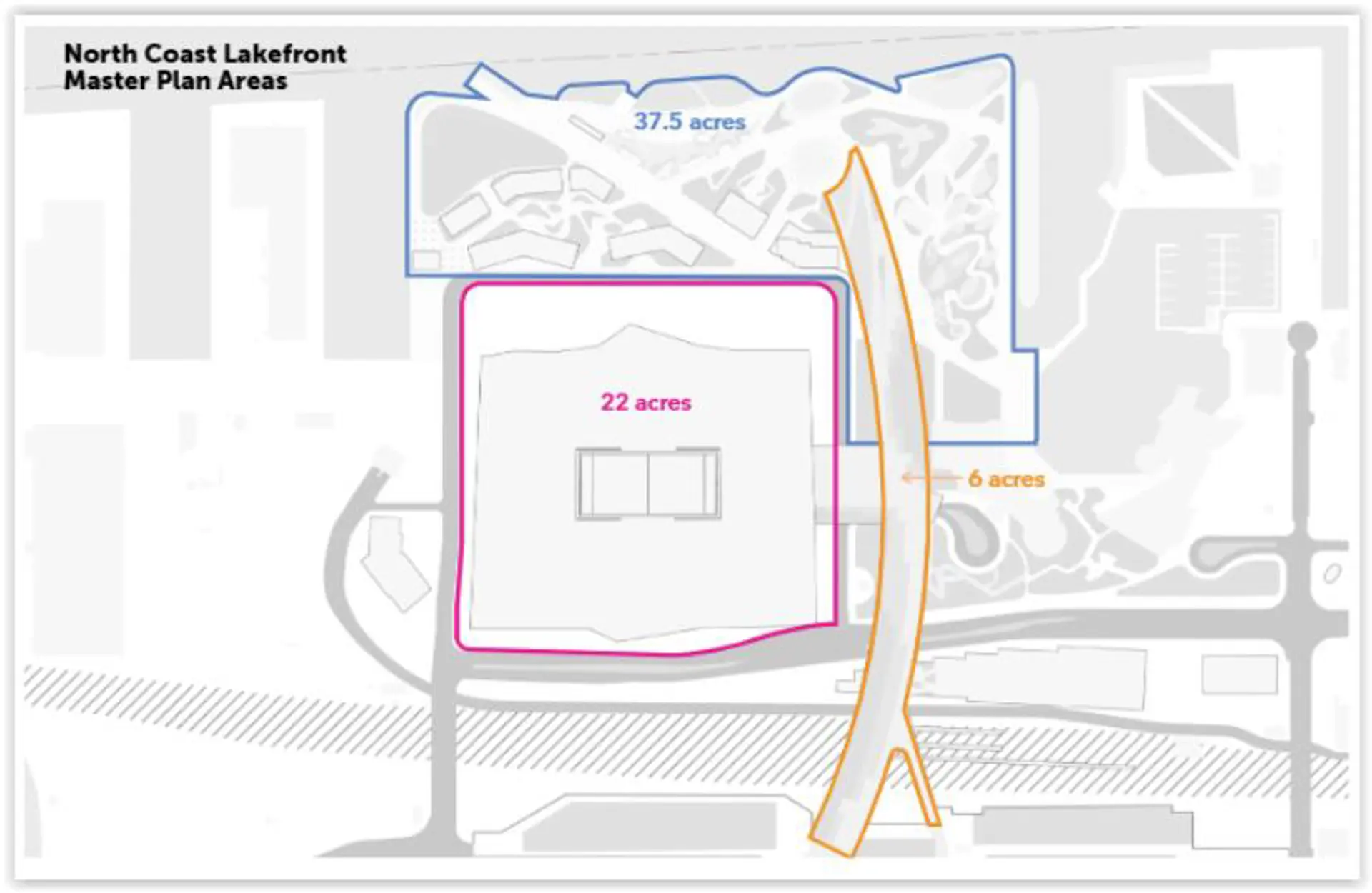
“The land that the stadium is on is entirely outside of the flight path,” Skinner said. “They’re not limited there.”
Even at the water’s edge, near the Steamship William G. Mather Museum which is the part of the development site that’s closest to Burke, new buildings would be restricted to about five stories tall. At the water’s edge at the western portion of the development site, the height limit rises to about 15 stories.
The city is seeking federal help in closing the 450-acre Burke Lakefront Airport, which it considers redundant and not the highest and best use of lakefront land. The city and the commercial airlines that serve Cleveland Hopkins International Airport subsidize Burke at about $1 million per year. All airports in Greater Cleveland are operating at well below capacity.
Ward 17 Councilman Charles Slife expressed additional concerns at yesterday’s meeting about increased traffic congestion resulting from the proposed downgrading of the Shoreway highway into a boulevard with intersections at West 3rd Street, Erieside Avenue, East 9th Street and a future extension of East 18th Street.
But the city was awarded $150 million in state and federal funds to redo the Shoreway as a boulevard, with construction due to start in 2027. Some of the federal money comes from a fund intended to redesign or remove highways considered to be urban barriers.
The Ohio Department of Transportation welcomed redesigning the roadway because it said the existing 86-year-old Shoreway doesn’t meet modern highway safety design standards. But its traffic studies said the as-yet unfunded East 18th extension is needed to keep the West 3rd and East 9th intersections from getting too congested.
Earlier this week, Cleveland City Council approved a $100 million settlement with HSG that lets the Browns relocate legally unscathed to a planned new stadium in suburban Brook Park. Of that, $75 million will go to lakefront redevelopment including a $30 million demolition of Huntington Bank Field.
Beyond the settlement, city officials said HSG will not be participating in the lakefront redevelopment. That was echoed by HSG Chief Communications Officer Peter John-Baptiste in a text message to NEOtrans.
“Obviously, we’re very supportive of the reamigined lakefront but we haven’t discussed partnering with developers on the project,” John-Baptiste said.
For more updates about Cleveland, sign up for our Cleveland Magazine Daily newsletter, delivered to your inbox six times a week.
Cleveland Magazine is also available in print, publishing 12 times a year with immersive features, helpful guides and beautiful photography and design.

Ken Prendergast, NEOTrans
Ken Prendergast is a local professional journalist who loves and cares about Cleveland, its history and its development. He has worked as a journalist for more than three decades for publications such as NEOtrans, Sun Newspapers, Ohio Passenger Rail News, Passenger Transport, and others. He also provided consulting services to transportation agencies, real estate firms, port authorities and nonprofit organizations. He runs NEOtrans Blog covers the Greater Cleveland region’s economic, development, real estate, construction and transportation news since 2011. His content is published on Cleveland Magazine as part of an exclusive sharing agreement.
Trending
-
1
-
2
-
3
-
4
-
5