
Connected City: How Independence Is Using Technology and AI to Drive Innovation
Digital tools, data and artificial intelligence are transforming how the city serves residents, supports businesses and prepares for the future.
by Kristen Hampshire — Partnership Content | Sep. 3, 2026 | 9:00 AM

Courtesy City of Independence
A pothole disappears. A sewer problem is fixed. A permit moves forward. A new business chooses to invest in the community.
Behind each win, technology is playing a larger role in how Independence plans, operates and grows. From mapping infrastructure and digitizing city services to supporting AI initiatives at major employers, the city is embracing new tools to work smarter, respond more efficiently to residents and put data into action.
“We are working on bridging the gap between being tech-forward while still maintaining the gold standard of customer service Independence has always embraced,” says Dawn Olsen, who helps implement and support the software platforms used across departments.
Service Director Ron McKinley adds, “Capturing data so we can pull service reports, manage our inventory of vehicles and stay on track with resident requests is a game changer.”
Here’s a look at the city’s technology playbook-in-progress and stakeholder businesses that are supporting innovation.
Mapping a Smarter City
From roads and utilities to permits, trees and capital projects, the City of Independence is increasingly relying on geographic information systems (GIS) to bring data together and support better decision-making.
GIS allows city departments to visualize and analyze information based on location. Residents interact with similar technology every day through tools like Google Maps, but Independence is applying those capabilities to city operations.
“GIS is essentially the foundation of all of it,” says Chad Harris, GISP, city planner, economic development and planning specialist for the city.
Over the past several years, Independence has worked to consolidate fragmented geographic data into a single GIS platform used by departments including engineering, building and service, planning and economic development.
For engineers, Harris says GIS helps track infrastructure assets such as water lines, sewers, manholes and roadway conditions. Building and service departments use the technology to map permits, work orders and maintenance activities.
The city is also expanding its use of GIS for tree management, turning a recently completed urban tree canopy inventory into a long-term inspection and maintenance program.
In economic development, Harris says GIS is helping city leaders communicate complex projects more effectively. Harris recently launched an interactive online “story map” that allows residents to explore major capital projects through dynamic maps, visuals and project information.
Simplifying Service Requests
For residents, city services are often measured by outcomes. Behind the scenes, the City of Independence has been modernizing the systems that make those services possible.
Over the past several years, the service department has transitioned from paper-based processes to a largely digital operation. Work orders, fleet management, sewer inspections and maintenance tracking are now powered by technology that provides real-time information and historical data at the click of a button.
“Technology has helped us become an extremely efficient service department,” McKinley says.
One of the most significant changes has been the implementation of Tyler Technologies, a work order management platform that connects office staff and field crews. Work orders are created electronically and sent directly to tablets used by employees in the field, where they can document labor, materials and completed work without returning to the office.
“Five years ago, we did everything by hand, all written down on paper,” McKinley says of the city’s swift digitization. “Now we have a computerized, digitized work order management system.”
The department has also invested in GPS technology throughout its fleet. Vehicle tracking allows supervisors to monitor routes, verify service activities and respond quickly to resident questions. For example, during snow events, staff can confirm when a street was plowed, review vehicle activity and access video from forward-facing cameras mounted on trucks.
Sewer inspection cameras enable crews to locate blockages, calculate distances and document conditions throughout the system. Video footage is stored digitally, creating a growing database that can be used to track changes over time and identify recurring issues before they become larger problems.
Empowered Reporting
Olsen says the impetus behind many of the City’s technology initiatives is a simple goal: make it easier for residents to connect with city services. As project manager and information systems analyst for Independence, Olsen helps implement and support the software platforms used across departments.
Through Tyler’s MyCivic portal on the city’s website, residents can report common issues such as potholes, fallen trees, damaged street signs or other concerns directly through the city website. “Requests are routed to the appropriate department, converted into work orders and we can track the process until it’s completed,” she explains.
The platform also helps city staff manage permits, maintenance activities and other operational functions while providing a centralized system for tracking information.
These tools work hand in hand with the city’s broader technology infrastructure, including GIS mapping and asset management systems that help departments organize and share information more effectively, Olsen says.

Building an AI-Ready Workforce
When CGI selected Independence for its newest Northeast Ohio location, the decision was about more than office space. The global IT and business consulting firm views the city as a strategic hub for innovation, workforce development and collaboration with local universities.
CGI officially opened the Independence location this spring.
“We believe in living locally alongside our clients and delivering with global scale and capabilities,” says Doug Vargo, CGI’s U.S. AI Transformation and Alliances lead. “That means building lasting relationships, understanding local priorities and investing in the communities where we work.”
Vargo says partnerships are especially important as AI reshapes the workforce. And while a lot of discussion centers on AI replacing jobs, Vargo sees a different future.
“Northeast Ohio schools are producing AI-native talent,” he says. “These early-career professionals are coming out already understanding how to leverage AI and how that’s going to transform themselves.”
CGI has plans to play a role in this ecosystem by working with universities on real-world challenges, helping students gain experience while creating a stronger pipeline of skilled workers for Northeast Ohio employers.
Across the public and private sectors, CGI is working with clients to modernize legacy systems, improve customer service and make information more accessible through AI-powered tools.
Investing in the City
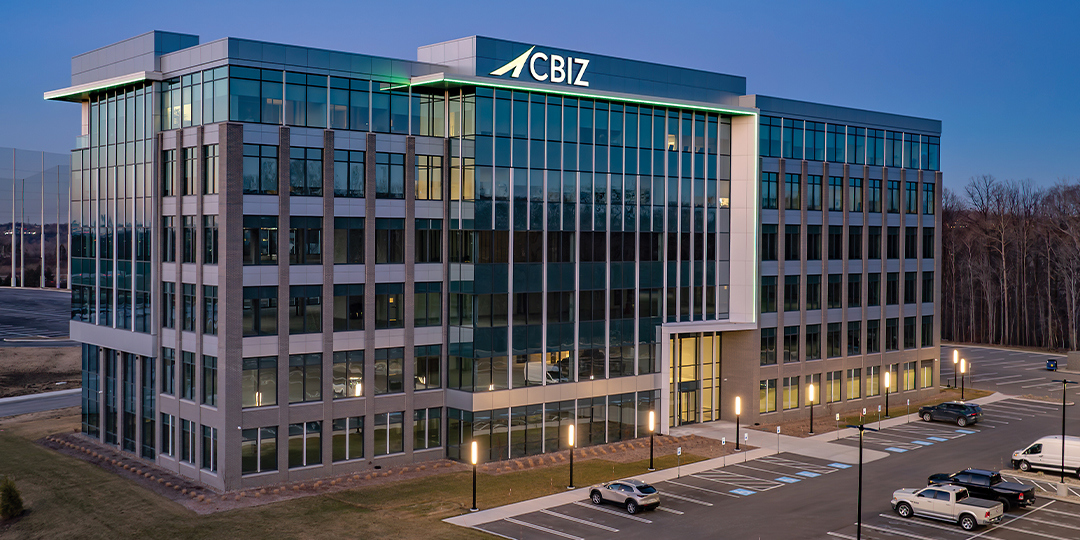
CBIZ’s commitment to innovation extends beyond artificial intelligence to its long-term investment in Independence.
CBIZ, which employs more than 9,500 team members nationwide and has called Independence home since its founding 30 years ago. Two years ago, CBIZ reinforced that commitment by becoming the anchor tenant in the city’s first new Class A office development in more than two decades.
According to Elizabeth Newman, chief human resources officer, the decision was driven by business and workforce considerations. “Our location allows us to pull talent from all areas across Northeast Ohio,” Newman says.
Newman credits the city and regional economic development partners with helping make the project possible. Collaboration among the city, JobsOhio, Team NEO and Greater Cleveland Partnership helped create an environment that has encouraged the company to grow in Northeast Ohio.
Today, the headquarters serves as a model for CBIZ offices nationwide, combining state-of-the-art technology, flexible workspaces and collaborative environments designed to support the company’s people-first culture.
A focus on people is also shaping the company’s approach to AI.
Before launching its recent partnership with Microsoft, CBIZ developed its own AI-powered platform and recorded more than a million interactions as employees explored ways to integrate artificial intelligence into their daily work.
Today, the company’s focus extends beyond technology adoption to workforce transformation.
“AI adoption is less of a technology problem, more of a people opportunity,” says David Fisher, vice president of artificial intelligence.
By embedding AI into familiar tools such as Word, Outlook, Excel and PowerPoint, CBIZ is helping employees automate routine tasks, uncover insights faster and spend more time delivering value to clients.
For CBIZ, AI is not about replacing human expertise. It’s about enhancing it. And this philosophy aligns closely with the vision behind the Independence headquarters. “Community engagement and our partnerships and relationships in the community are a big part of our culture,” Newman says.
Trending
-
1
-
2
-
3
-
4
-
5