
How Coder Mel McGee Adapted to AI and Started Teaching Cleveland Businesses To Do the Same
Mel McGee shows how AI can help navigate busy days in the office and open more space for creativity.
by Travis Sawchik | May. 8, 2026 | 5:00 AM

Photographed by Kevin Kopanski
When I reached out to Mel McGee requesting an interview a few weeks back, we had never met. She had no idea of my background, writing style or manner of asking questions.
She also did not have much time to prepare.
McGee is the founder and CEO of two Cleveland-based companies — SkillSpout, an AI strategy training firm, and We Can Code IT, a sort of general tech training provider. She’s spinning several plates: three calendars, multiple email accounts, client deliverables, proposals, a HubSpot CRM with an active pipeline, meeting prep and financial tracking. The list goes on. And she’s doing all of this while keeping pace with the fourth industrial revolution: AI.
So she built something to help.
McGee created her own AI operating system to manage her day, save time and assist with decision-making. It’s so new she hasn’t settled on a name.
“It wants to be called ‘Exocognition.’ That’s what it thinks it should be called,” says McGee, a Case Western Reserve alumnus.
McGee shares her screen. The interface is simple: a chat window titled “Cleveland Magazine prep.” On the left side is a column filled with a summary generated by her AI agents. On the right is an empty prompt box.
The summary reads like an intelligence briefing — on me.
Her system generates these briefs each morning, AI agents anticipating what she’ll need. The summary includes biographical details about me that anyone could find with a Google search, but it follows with an assessment. It reasons. The scouting report concludes that I am “a serious journalist,” I ask “real questions,” and I specialize in “data-driven storytelling.”
(I’m starting to like this bot.)
“It tells me all of this. I didn’t do any of this,” she says.
The system’s agents study her calendar, emails and documents to anticipate needs. Her goal was to make the tool predictive, not reactive.
“It’s almost like someone puts a brief together for you, places it on your desk and gets you ready for the meeting,” McGee says.
She types a prompt into the chat box: “Travis is here with me right now. What can you tell him about the system? What are some of the main things we’ve learned?”
“Thinking…”
Thirteen seconds later, the agent produces a summary touching on the “proactive engine” for meeting prep and follow-ups, and the “delegation engine” that routes tasks to employees based on roles, past decisions and performance.
How much has it helped?
“One day might now be 30, but it might be 90. I don’t know,” she says, trying to quantify her gains as a developer. “For our (SkillSpout) trainers, it helps them prepare content, build portals, create presentations and outlines. It’s not two or four times anymore — it’s leaps and bounds beyond anything I imagined.”
AI is helping her do more. And she wants others to do the same.
SkillSpout’s mission is to help small- and mid-sized organizations adopt AI through a “human-first approach.” We Can Code IT focuses on empowering underrepresented groups in technology.
The impact is tangible.
One client that ships large volumes via FedEx built a bot to audit invoices and receipts; it found roughly 5% of billings were overpays, saving hundreds of dollars per day. Another, Anthony Milia of Milia Marketing, said the biggest win from SkillSpout wasn’t the 78% reduction in proposal time, “it was what we did with the time we got back.”
In April, McGee said SkillSpout plans to launch “The Current,” a personalized AI learning platform with role-tailored video libraries, tracking engagement, and adoption and growth measurements.
These are examples of AI as a tool that augments human work. But the fear around AI isn’t about what it assists. It’s about what it replaces.
As our conversation continues, McGee types in another prompt: “Do we have personalized videos for Travis?”
The AI bot responds: “Formulating…”
Minutes later, her AI system produces a complete video with slides and an automated narrator. What might have taken a human assistant a week is done in minutes.
That’s where the tension resides.
The same efficiency that creates opportunity also fuels anxiety. In recent months, companies like Meta, Amazon and Block have cut thousands of jobs citing AI. Research by ARK Invest’s Brett Winton estimates AI-generated words have now surpassed those produced by humans.
The implications stretch across legal work, accounting, consulting, education, finance and media. Andrew Yang dubbed his predicted culling of white-collar jobs “The Great F---ening.” A record 25% of the unemployed now hold college degrees.
In some ways, McGee has lived this shift. As a child, her father brought home a Commodore 64 and told her, “You’ll love this, Mel.” She taught herself to code; her first project was an infinite loop of her name scrolling across the screen. Being a coder became her identity. But AI can now write code better than any human. So she adapted — from coder to creator.
While fear of job loss is real, so is the potential for new work. SkillSpout employs 14 people in roles that didn’t exist before 2024. Just over a year old, the company surpassed $1 million in revenue last year and expects accelerated growth.
Nvidia CEO Jensen Huang noted on a recent podcast that radiologists are actually increasing in number despite AI predictions.
“You have to go back to what is the purpose of a job,” Huang said. “The purpose of a radiologist is to diagnose disease, not to study the image.”
McGee shares the view.
“I’m guessing you didn’t get into writing for punctuation,” she tells me. “I didn’t get into coding for that either. I got into it because I wanted to create. I love innovating. I love building systems.”
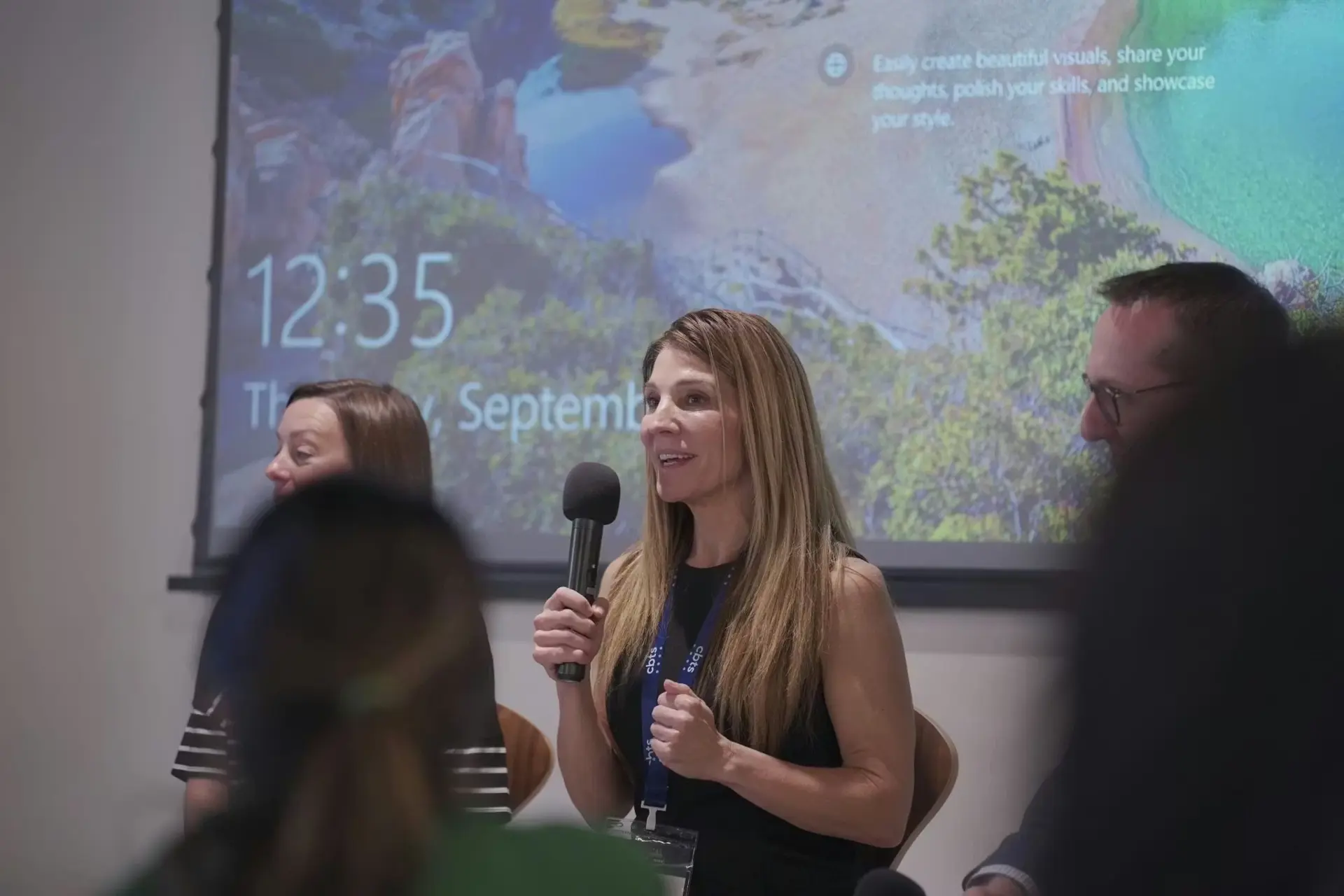
There are limits to what she will automate. She doesn’t allow AI to send emails automatically; she reviews and edits everything.
Final decisions?
“Never.” AI shouldn’t have total autonomy, she says.
She also acknowledges a major flaw: “If you go into an AI tool and say, ‘Make me an image of an entrepreneur,’ it probably won’t look like me. Ask for a nurse — it’ll probably be a woman. AI reflects human bias. So we have to be careful. We have to use judgment.”
She understands bias. No one looked like her in her Cleveland State University computer science classes.
Some compare the AI revolution to the Model T replacing the horse. The question is, are we the horse? Or are we the driver of a more powerful machine? For McGee, the bigger concern isn’t replacement — it’s access. Democratizing access is at the core of her mission.
“How do we train people so they can use AI and leverage it?” she says. “That’s my fear — that people who don’t adopt it are going to get left behind.”
For more updates about Cleveland, sign up for our Cleveland Magazine Daily newsletter, delivered to your inbox six times a week.
Cleveland Magazine is also available in print, featuring immersive stories, helpful guides and beautiful photography and design
Trending
-
1
-
2
-
3
-
4
-
5