
Whitney Haslam Johnson and JW Johnson Are the Future of the Browns. Can They Build a Winner?
Jimmy and Dee’s daughter and son-in-law hope to find the right path in Haslam Sports Group's quest for a world-class stadium and a Super Bowl ring.
by Dillon Stewart | Aug. 31, 2026 | 12:00 PM

JW Johnson and Whitney Haslam Johnson are shaping the future of the Browns. | Photographed by Ken Blaze
A painting of the Muni Lot stretches from floor to ceiling in the lobby of the offices at CrossCountry Mortgage Campus, the Cleveland Browns’ headquarters in Berea. The contemporary folk art piece depicts an eastward bird’s-eye view of the hallowed plot of asphalt between the Shoreway and the RTA tracks on game day. The rudimentary figures are obscured, but they are grilling, parking, throwing footballs, sipping label-less cans and starting the mile-long walk to the stadium, which is out of frame. One can pass the time before a meeting by playing a game that many Clevelanders frequently play at the stadium on Sundays, or during halftime or a blowout: “I Spy” a jersey of an obscure, forgotten Browns player. A couple 19s. A 4. A 57. Those are easy. Why so many 31s? Jamal Lewis, who rushed for 1,000 yards in both 2007 and 2008? I paid $14 to see him and the 4-11 Browns lose to the Bengals in 15-degree December weather. A lakefront 15. No, probably Frank Minnifield, the Pro Bowl cornerback from the ’80s.
Did you know the Browns are moving to Brook Park?
Of course you did. Everyone does. For the past year, overshadowing the Deshaun Watson debacle or the Myles Garrett sack record or the subsequent trading of said defensive superstar, the debate surrounding the stadium — a year-long battle with the city of Cleveland that led to a lawsuit — dominated Browns discourse. Cleveland Mayor Justin Bibb called the move “a betrayal of Ohio taxpayers.” An illustration of Browns owner Jimmy Haslam’s face stood alone on the cover of Cleveland Scene’s 2024 “Worst of Cleveland” issue. Fans, 57% of whom wanted the team to stay Downtown, according to a 19 News survey, dubbed the team the “Brook Park Browns.”
Would they really do it? How would they do it? Why would they do it? Now you have your answers: Yes, they are doing it. With $600 million in state funds, $245 million from Brook Park, $1.76 billion of Haslam Sports Group money, and a $100 million kumbaya payoff to the city of Cleveland. Because they can build an epic, modern, domed, $2.6 billion stadium with 67,500 to 75,000 seats and — despite saying “we’re not out to make money” — the ability to profit off of every aspect of the experience, down to parking at the tailgate lot.
The questions that now remain are more spiritual than political. Will the “blue-collar fans,” as they’re so frequently referred to, be priced out of tickets and parking? As existing personal seat licenses (PSLs) expire with the move to the new stadium, how will the Browns honor longtime season-ticket holders? Beyond providing credits toward new PSLs based on the value of their current licenses, will years of loyalty factor into the process? Like that painting, devoid of barks, blunt smoke and costumed men gnawing dog bones and bonging beers, will the ritual by which so many Clevelanders define their Browns fandom be sanitized, plastic and corporate?
Can two billion dollars manufacture an experience that wasn’t engineered in the first place?

James Woods “JW” Johnson III and Whitney Haslam Johnson walk in through the front door of the lobby in safety vests and orange hard hats with a Browns stripe down the center. Wearing golf attire, JW plants a strong, assertive handshake and booms a hello. Whitney, ever-stylish in a smart-casual skirt and blouse and wispy, shoulder-length blonde hair, follows with a welcoming smile.
Jimmy and Dee. Dee and Jimmy. When the average Browns fan talks about the Browns’ ownership, two names come up. Rightfully so. As the leaders of Haslam Sports Group, which oversees a more than $12 billion portfolio that includes ownership of the Browns, the Columbus Crew of the MLS, the Milwaukee Bucks of the NBA, an expansion National Women’s Soccer League franchise in Columbus and stakes in numerous companies such as Homage T-shirt company and gambling site jackpot.com, the patriarch and matriarch are still very much the masters of the Haslam universe.
Yet, many fans might not realize that Haslam Sports Group is more four-headed than two-headed. Year-round, JW and Whitney rove the halls in Berea, hold court in glass-walled conference rooms and handle the minutiae of maintaining these global brands. Heading into the 2026-2027 football season, they’re also overseeing the progress of two massive development projects in Berea and Brook Park.
They are also the ones ingrained in the community on a personal level. They live in Shaker Heights. They have three boys, all in or nearing high school, who attend and play sports at University School and Gilmour Academy. The family hikes and fishes and hosts cookouts with grandma and grandpa (JW mans the grill, as Jimmy “can’t make a PB&J sandwich,” JW says). They’re part of carpools to practices and school events, coordinated through group texts that buzz throughout our conversation.
The couple has largely stayed out of the limelight, eclipsed by their parents, yes, but also, perhaps, reluctant to let themselves shine. JW, who comes from the media world, has been more forward-facing. Since coming on full-time in 2018, he’s often present in personnel meetings and in the postgame locker room with Jimmy. He’s been known to appear on local podcasts and spar with fans and journalists on social media platform X. Whitney — who spent 18 years at Pilot, the company Jimmy’s dad started, and Pilot Flying J, including seven years running it, before turning her attention to HSG — has operated slightly more in the shadows, focused on finding balance between being a corporate executive and a mom.
Meanwhile, Jimmy and Dee, both 72 years old, don’t plan to kick up their feet with cocktails on the beach any time soon. “Yeah, that’s not in the cards,” says Dee. “Jimmy and I love to work. We love what we do.” Still, when the Haslam Sports Group team talks about the future, they talk in terms of a 50-plus-year plan: a new stadium built to last, a football team that can hopefully turn the tide on decades of failure, and a succession plan that eventually puts JW and Whitney in the driver’s seat, as the leaders of the Cleveland Browns and Haslam Sports Group.
“They’ll lead our family business,” says Dee. “When they moved here eight years ago, they moved here for that specific reason.”
“The only question,” Jimmy says, “is when.”

JW and Whitney stand at the 50-yard line of the new Huntington Bank Field. The couple turns in circles, gawking at the massive jumbotron and pointing out where the family’s suite might be, right above the home sidelines. They can almost reach out and touch the 6,500 fans in the Dawg Pound, which has a first row just 16 feet from the field and a slope of 34 degrees, the steepest in the NFL, designed to put fans as close as possible to the action. Its position on the west end creates an imposing wall of rabid Browns fans right outside the visiting team’s tunnel.
“Wow, this is incredible,” JW says softly.
The field and the fans, of course, don’t yet exist. They are merely digital renderings and extras inside The Immersive Cube, a more-than-20-million pixel LED screen that displays renderings on three walls, the floor and the ceiling of a 12-by-12 room. Akin to Sphere in Las Vegas, the space creates a life-like experience of walking into the stadium or grabbing a snack at the concession stand or sitting in the Dawg Pound — or flying like a bird over a sea of tailgaters in the parking lot.
Whitney and JW are experiencing the technology for the first time. Whitney’s gears turn. Even the rendering, often the most idealistic version of a development, isn’t quite done yet.
“When we talk about doing the seats in brown-and-orange stripes, the problem is you’ll have to move the aisles, which might not work with the steel beams,” Whitney tells a Browns employee. “We did yellow at the Crew stadium, but orange is different than yellow. A little bit goes a long way.”
The Cube is the main feature of the Sales Experience Center, a new structure that opened on the southwest side of the longstanding HQ last month. Joining conference rooms and event spaces, the video screen helps the sales team show off a sponsor’s logo placements or a season-ticket holders’ view.
If anything about the Brook Park stadium keeps Whitney up at night, besides the day-to-day headaches of construction snags and potential cost overruns, it’s putting butts in seats, including 167 luxury suites alongside 12 club spaces.
“We have a lot of suites to sell,” says Whitney, “a lot of products.”
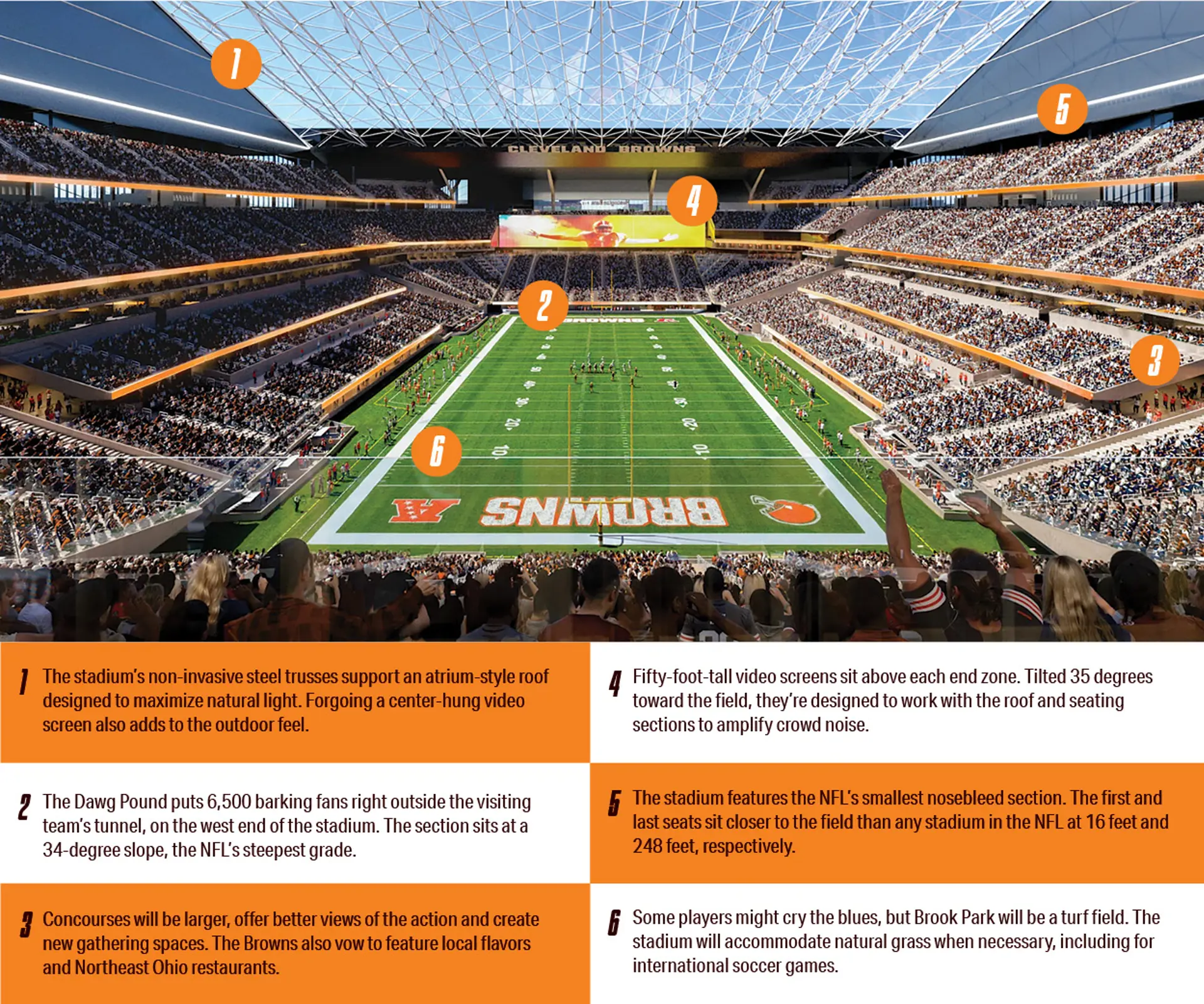
More than just suites, the Haslams are on a mission to sell Huntington Bank Field to Browns fans as not just an experience but a Cleveland experience — one that can give the region a boost at the same time. The team’s studies point to the generation of 5,400 jobs and $1.2 billion in annual economic impact, including a boost to Downtown. (Other analyses dispute those numbers, especially Downtown, where estimates suggest a loss of $30 million in economic output, $11 million in tax revenue and hundreds of jobs.)
When the Haslams tapped Lance Evans, venue designs director and principal at HKS Architects, to design the new stadium, he wanted to feel the energy of the Browns faithful. He didn’t ride up to the gate in a limo and sit in the Haslam suite. No, he joined the revelry of a Muni Lot tailgate. He barked in the Dawg Pound.
“The atmosphere of the Dawg Pound really was contagious,” he says. “The ritual before the game starts is truly unique and special (compared to what) I’ve seen around the league.”
Evans would know. His firm led or contributed to SoFi Stadium in Inglewood, California (home of the Los Angeles Rams and Chargers, and the Super Bowl this season), U.S. Bank Stadium in Minneapolis (home of the Minnesota Vikings), AT&T Stadium in Arlington, Texas (home of the Dallas Cowboys), and Lucas Oil Stadium in Indianapolis (home of the Indianapolis Colts).
When Evans began discussions with the Haslams four years ago, the Browns owners didn’t want to replicate those stadiums. Those projects work because they’re defined by a sense of place, Evans says. They take climate and culture into account. That’s what gives a building relevance decades later.
Evans didn’t need to look far for buildings that lasted. The architect visited Cleveland’s most prominent spaces to learn the local design language that he needed to create a Huntington Bank Field that felt like Cleveland’s stadium. The atriums of the Cleveland Museum of Art, the Rock & Roll Hall of Fame and the Old Arcade inspired the design of the most prominent feature: the domed roof. The custom folded-plate transparent roof will be specially designed to withstand snow accumulation and drastic weather changes. Discrete steel trusses will bathe the coliseum in natural light.
“The buildings that spoke to me were ones that have stood the test of time,” says Evans. “There’s a legacy to the city, which I just found really intoxicating.”
Opened in 1999, the current Huntington Bank Field was not built for permanence. Or if it was, that mission failed. After Browns owner Art Modell announced he’d move the team to Baltimore, the NFL promised Cleveland an expansion club if the city agreed to build a new stadium for the 1999-2000 season. Designed by HOK Sports Facilities Group, the same firm that built Jacobs Field, the 1996 plans, completed under Mayor Michael White, were hastily made. The $247 million open-air stadium was primarily publicly funded, though the league pitched in $43 million. Financial constraints prevented a dome, though one was discussed. Its video screens were considered state-of-the-art, but that was about it. The 73,000-seat stadium (later reduced to 67,500) hosted its first regular season game on Sept. 13, 1999. The Pittsburgh Steelers walloped the Browns, 43-0, in a primetime game on Monday Night Football.
“The stadium on the lakefront was built in a different era,” Evans says. “Stadiums were more utilitarian in their focus, and as the league and fans’ behaviors have evolved, the building type has evolved, too.”
Since 2007, the city of Cleveland has paid more than $50 million for capital repair projects, such as accessibility improvements and electrical work. An audit in 2024 said the stadium would need $117 million of construction just to keep it playable. A full renovation on the lakefront would have cost more than $1 billion, Haslam Sports Group estimated. All the while, the city is still paying off the original cost of the stadium build, $9.3 million a year through 2028, and spends about $19 million annually on total stadium costs — $2 million more than the city collects each year in taxes and other revenue directly related to the stadium, according to cleveland.com.
“This new building and the development around it will hopefully bring the fans into the next generation of the Browns,” says JW. “Cleveland deserves nice things, and this will be one of the nicest things in the city of Cleveland and the county.”

Today’s sports fans want more than a good game. Surveys show fans now desire better food options, premium seats, digital integration, pregame entertainment and fan zones. The lakefront building’s spatial constraints, the architect says, limit real estate for enhanced concourses and gathering spaces.
“Captain” Steve Weber has been a season-ticket holder since 1985. In 2013, he created the Greatest Northern American Tailgate Society (better known as GNATS) and now welcomes more than 1,000 fans per game to The Pitt tailgate lot. He also organizes meetups at away games, which has brought him to more than 18 stadiums.
“I’ve been begging for a new dome stadium,” he says. “The stadiums that are out there in the NFL, they’re unreal. It’s like, why can’t we have nice things? When (the Haslams) said they were going to make it the best stadium in the league, I was ecstatic.”
The evolution can be seen across professional sports. Las Vegas’s stadium, opened in 2020, features an end-zone nightclub. The Buffalo Bills, who will christen the new Highmark Stadium this year, have localized their experience with an art program and food stalls organized by Buffalo neighborhoods, with local restaurateurs serving as vendors — all within view of the game. Even in Cleveland, Progressive Field removed thousands of seats to emphasize experiences like the Corner Bar in right field, the Kids Clubhouse and the North Coast Social, which replaced the former Terrace Club with a gastropub.
Over the next five years, D.C., Denver, Chicago, Tennessee and Kansas City all hope to have new homes. Every one of those projects includes a “mixed-use development.” The Atlanta Braves’ Truist Park, which the Haslams cite as an inspiration, is surrounded by The Battery, a 75-acre collection of restaurants, entertainment venues and hotels located in Cobb County, Georgia, about 10 miles outside the city. The Battery’s mixed-use business generated more adjusted operating profit than Atlanta’s baseball business in 2025. The Chicago Bears, as they move on from the 102-year-old Soldier Field, are so desperate to repeat the formula that they’re even considering a move to Indiana, 20 miles (in Chicago traffic) outside the city.
The stadium debate gave many Browns fans flashbacks to The Move, partially motivated by Modell’s desire for a new stadium. The family never considered anything much farther than the 12 miles to Brook Park — especially a move to Columbus or out of the state.
“We were never really thinking about leaving the region,” says JW. “Columbus wasn’t an option.”
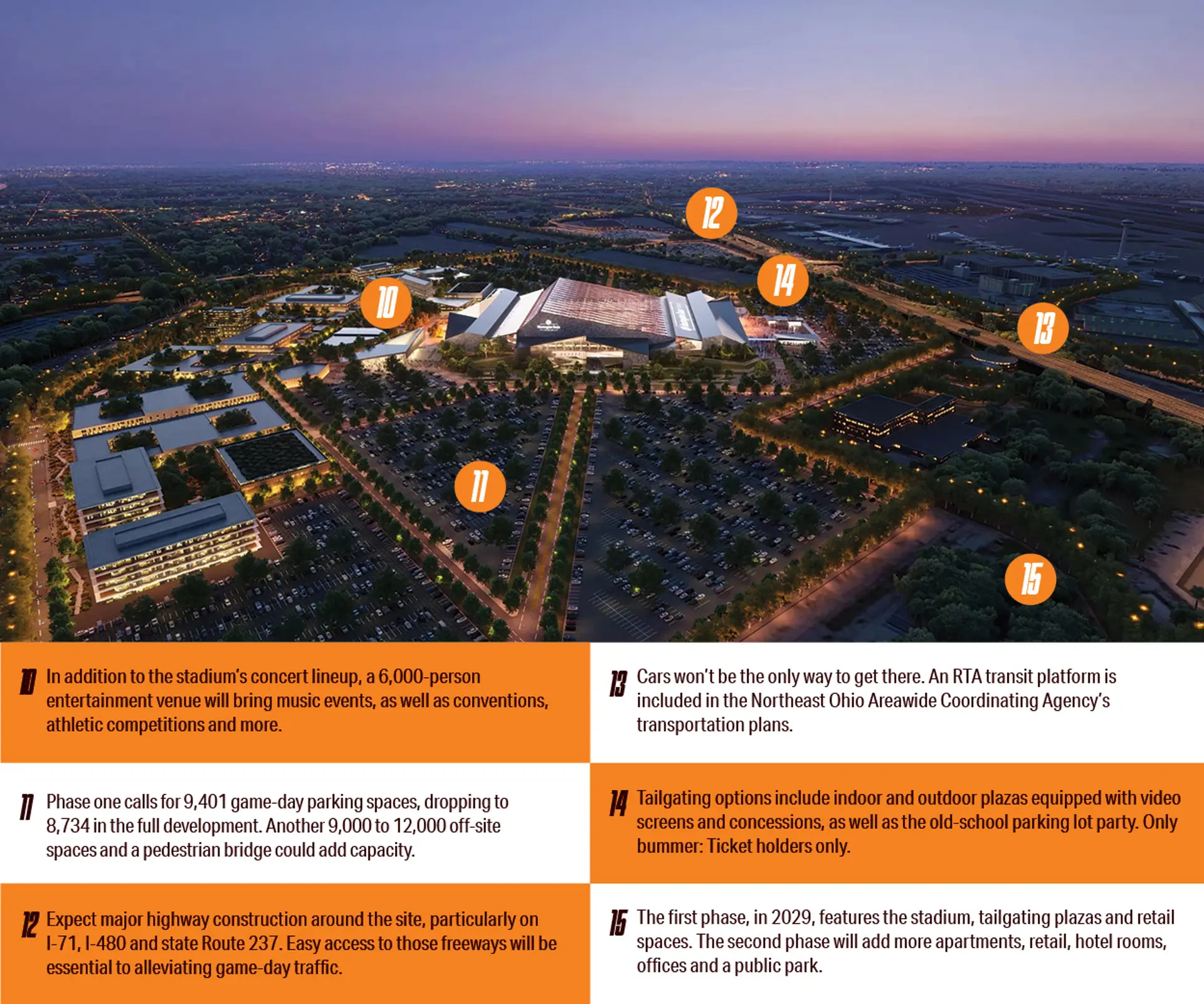
The ability to fulfill the vision for a 176-acre mixed-use entertainment district bound for Brook Park was important to the decision, though. The Haslams hope the stadium attracts 15 to 20 large-scale events per year, such as a Taylor Swift concert, WrestleMania, World Cup soccer games or the Final Four. The target of more than 50 events per year includes “flat-floor events,” Jimmy says; the type that the I-X Center used to host, like car shows and industry conventions. In the meantime, Haslam Sports Group is leasing the I-X Center, keeping events like the boat show here in Cleveland.
Additionally, plans include a standalone indoor music venue and event center. The space, located on the Brook Park campus, will have a capacity of about 3,000-4,000 people, a bit smaller than the 4,000-5,000-capacity Jacobs Pavilion in Cleveland.
Jimmy has argued that the stadium could even position Cleveland to win the mother of all events: the Super Bowl. At the stadium’s groundbreaking ceremony in April, NFL commissioner Roger Goodell said he does not doubt that the stadium will be “Super Bowl-ready,” but that Northeast Ohio lacks the surrounding infrastructure — five-star hotels, golf courses, restaurants, etc. — to host the 20,000 people who invade the host city of the Big Game in February.
“We’re going to be able to finally compete with surrounding cities for the best events in the United States,” says Whitney.
On Sundays, that entertainment starts in the parking lot, where fans (with tickets) can still literally tailgate — behind the car, the old-fashioned way. You can also kick off the day in the Tailgate Plaza, a space outside the stadium with concessions and a big screen playing pregame pump-up content. After getting your ticket scanned, enter the Fan Plaza, a large outdoor gathering space, before progressing directly to the mouth of the new-and-improved Dawg Pound.
Much like offense, defense and special teams units must work together to win a game; the Xs and Os of entertainment, fandom and luxury must mesh for this project to be a success. Luckily, JW and Whitney are uniquely suited to bring it all together.

Family businesses aren’t easy, but they’re all the Haslams know.
James Arthur Haslam II, better known as “Big Jim,” started Pilot in 1958. Big Jim was an offensive lineman for the 1951 Tennessee Volunteers’ national championship team and a veteran of the Korean War. Jimmy, his son, joined the company in 1976, when he was still a senior at the University of Tennessee.
By the time Whitney was born, her grandfather’s Pilot Company, as it was known before a 2010 merger with Flying J, was already a $30 million business with about 50 gas stations. Two years earlier, the company launched its first convenience store — a move that led to building travel centers in 1981 and rapid growth over the next two decades. In 1996, when Jimmy became president and CEO, the company had grown to 96 travel centers and 1.2 billion gallons of annual oil sales.
No matter how big Pilot got, Whitney’s childhood memories of the company ring similar to those raised within any family business. She’d run around and chat with customers and employees, from whom her father received and noted feedback. She watched her parents pitch in on odd jobs when needed.
Today, her parents and collaborators describe her as “incredibly competent,” “process-oriented,” “detailed” and “matter-of-fact.” But not all of those were necessarily qualities her parents saw in her as a child.
“No, we did not,” says Dee, as she and Jimmy burst out laughing.
“High energy,” says Jimmy. “Let’s just put it this way: She’s much easier now than when she was a kid.”
“When I look back on it,” says Dee, “she would tell us what she was doing or not doing. ‘I’m not going here. I’m not doing this. I’m not doing that.’ She was pretty much in charge a long time ago.”
Whitney grew up as an athlete and a Tennessee Volunteers fan. She particularly excelled at swimming but also played soccer, softball and basketball. Her experience in female youth sports later drove her initiative to expand access to girls’ flag football leagues in Cleveland and the NWSL team in Columbus, and her love of Lady Vols basketball coach Pat Summitt inspired her and her mother’s 2022 capital investment in the WNBA.
Despite bleeding orange and white, Whitney attended the University of Georgia, earning a finance degree. When she graduated in 2001, her parents encouraged her to gain outside experience before joining the family company. She began her career as an assistant controller with Marriott International. In 2004, she led fundraising efforts in the Southeast region for the Bush-Cheney campaign before joining the family business, Pilot Company, in 2005.
JW grew up in New York City, Manhattan, until he was 10 or 11. He was an only child, and his father was in and out of his life. His mother, who started and operated her own public relations firm, moved him to Sharon, a small town in the northwest corner of Connecticut. He was a Cowboys fan from birth: in its Doomsday Defense era, the team lost the Super Bowl to the Steelers on the night his mother went into labor. The fandom continued as a rebellion against his father’s love of the New York Giants, and he picked up the Texas Rangers to counter his dad’s New York Yankees. As a well-rounded athlete, however, JW’s focus was on the ice, where he was a 6-foot-3 goaltender with NHL ambitions.
JW awoke from those dreams on the ice but found another way to stay close to sports. At 17, he began working at CBS Sports as a runner at the U.S. Open Tennis Championships. The next summer, he worked PGA Tour events and continued to do so through his time at the University of Mississippi in Oxford. After school, he joined CBS full-time and earned an Emmy Award as an associate producer and associate director, covering events such as the Masters, the Super Bowl and the Final Four. He spent 15 years there before joining RIVR Media, owned by Dee Haslam. In 2014, he started a creative agency and production company, 3 Sons Media, where he created in-game videos for the Tennessee Titans and the Browns as well as content for Nike, ESPN, NASCAR and PGA.
Whitney and JW met at a wedding in Savannah, Georgia, in 2007. “We hit it off and ended up talking all night,” JW says. A set-up: mutual friends knew they would bond over their love of sports, including both playing goalie on their high school soccer teams. Later that week, JW called her and said, “One way or another, I’d like to see you again.” They got married in 2009 and had their first of three boys, Hank, in 2010.
“She’s darn beautiful. She’s funny. She’s got a big heart, and she was just easy to talk to,” JW says. “We laugh a lot, especially because of these three boys. We’re still very much in love. It’s still very easy.

Jimmy admits he made mistakes when Whitney joined Pilot in 2005. He couldn’t afford a similar misstep when Whitney and JW came on with the Cleveland Browns.
Thirty years after joining the company, Jimmy’s Pilot was very different from Big Jim’s. With a penchant for operations, a part of the business his dad didn’t like, Jimmy fell into his role naturally, offering a yin to Big Jim’s yang. Whitney, who walked into a company that had grown from a $50-ish million company into a multi-billion-
dollar powerhouse with thousands of employees, didn’t immediately find her place.
“We did not onboard or set her up for success at Pilot as well as we should,” says Jimmy. “It was a big jump in. We kind of made her figure it out herself.”
Whitney started at Pilot as a category manager before moving to the marketing side of the company. The creative position was thrust on her by then-president Ken Parent, who became a mentor. The opportunity helped her find a groove. Eventually, she became vice president of brand and customer experience in 2013 and then chief experience officer in 2017. She quickly launched an extensive rebrand, widespread renovations of the travel center facilities and an expansion of the company’s customer loyalty programs, while veering the marketing strategy into the sports world. In 2024, the Haslams sold the company to Berkshire Hathaway, the holding company chaired by Warren Buffett.
“Coming out of college, I’ll be honest, I wasn’t sure that I wanted to work for a truck stop,” Whitney told Sports Business Journal in 2018. “But I pretty quickly learned that the job really is more about people and engaging with those people, whether it’s at one of our travel centers or at a football game.”
JW and Whitney joined the Browns in 2018, a strenuous time.
The team was in disarray, going 1-31 in 2016 and 2017. Head coach Hue Jackson, who would be fired midseason a few months later, was on thin ice. But there were some bright spots. The team picked defensive end Myles Garrett No. 1 overall in the 2017 draft, and in 2018, the Browns selected Baker Mayfield, who had just won the Heisman Trophy as quarterback of the Oklahoma Sooners.
The Johnson family had also just moved to Cleveland. As parents of young kids, JW and Whitney had grown tired of commuting from Nashville to Cleveland. So, they found a 1927 brick Georgian-revival house in Shaker Heights and redesigned it to make it home. Enrolling the boys at University School, where Whitney now sits on the board, helped the family quickly create a tight-knit community of like-minded parents. “It was a leap of faith,” says Whitney.
To further ease the transition — and protect the family unit — Jimmy and Dee hired an executive coaching firm to create a blueprint for the shared leadership model. Dee says the consultants helped guide the family through “really tough” conversations.
“It’s not all rainbows and butterflies” says Whitney. “But we communicate, and we work through it, knowing that we all want to win, we all want to provide the best fan experience, and we all want to be really involved in the community. We keep that at the center.”
The coach’s main goal was to define each member’s role. Their skill sets complemented each other well. Jimmy, the big-picture visionary and larger-than-life personality. Dee, the community-minded one, on local philanthropy projects and the league’s social justice, conduct and legislative committees. JW, the sports media-minded strategist who aligns the goals of the business, marketing and corporate sponsorship. Whitney, the expert in branding and consumer experience.
“Any time four people work together, whether they’re related or not, things can be a little complicated,” says Jimmy. “We’re still feeling each other out occasionally at times. Occasionally, somebody oversteps their bounds. But for the most part, we have worked together really well.”
Most of the time, Berea feels like what it is: the HQ of a multi-billion-dollar corporation. But like a family business of any size, Haslam Sports Group has its quirks, too.
“We joke about it all the time,” says Peter John-Baptiste, chief communications officer of the Browns and Haslam Sports Group. “You feel like you’re at a family dinner table because Dee will be snipping at Jimmy. JW will be elbowing someone under the table.”
“A lot of times, it definitely feels like you’re working with colleagues,” says David Jenkins, chief operating officer of the Browns and Haslam Sports Group, “but of course, there’s moments when glimpses of family appear. Maybe there’s just a different level of comfort in pushing each other in those scenarios because you’re family, which ultimately probably gets you to the best possible outcome, because you know you’re walking out that door aligned, sharing the same goal.”

The buzz of construction overpowers the cheers and whistles of training camp at CrossCountry Mortgage Campus. Workers put the final touches inside the Sales Experience Center. Others work on the facade of the adjacent sports medicine building or erect beams for the new buildings across the street.
With all the focus on the stadium and its impact on Brook Park, it’s easy to forget the massive project going on at Browns HQ and how it’s set to change the face of Berea. Long before Brook Park is much more than a hole in the dirt, Berea will begin seeing the impact of Haslam Sports Group’s investments.
The CrossCountry Mortgage Campus expansion project is a 17-acre reworking of the Berea campus. Privately financed, the $175 million plan, led by DiGeronimo Cos. and Independence Construction, is set to create a multi-use neighborhood where people can live, work and play. First up is a University Hospitals sports medicine center for both players and civilians who have UH as their providers. The mini-neighborhood will also include a content studio for the marketing team, more offices, about 150 market-rate apartments, 15,000 square feet of retail, and the 140-room Barker Hotel, part of the higher-end Marriott Tribute Portfolio. Renderings kind of look like Pinecrest or Crocker Park.
Perhaps the most impactful bit for Berea residents is the community stadium. Though the Browns can practice here (it won’t be their primary practice field), this facility is intended for public use. Scheduled for completion in 2028, the stadium will feature about 7,000 seats, artificial turf and space for multiple sports, serving everyone from youth players to adult rec leagues. Berea-Midpark High School plans to play its football games here, and Haslam Sports Group hopes to host outside sporting events like lower college division football games, soccer and lacrosse by building to organizers’ desired specs.
Haslam Sports Group has no timeouts, no ability to dwell on the present or get lost in building the future. By Sept. 13, when the Browns take the field against the Jaguars in Jacksonville, they must have named a starting quarterback, evaluating what they have in the aging Deshaun Watson and the very green Shedeur Sanders, while keeping an eye on the 2027 draft. Football is still at the forefront.
“Our ultimate goal is to win a Super Bowl,” says JW. “We want to win trophies. Everything we’re doing is leading to that.”
The best outcome of the paradox they face is a little like the Myles Garrett trade. Yes, you sacrificed a Hall of Fame player in his prime. But in Jared Verse, you got a much younger star at the same position who can contribute now, plus a slew of draft picks to build around. The worst outcome? Like the Deshaun Watson trade, selling the farm without much to show for it.
The regional impact of Taylor Swift concerts or even a Super Bowl is important — maybe even monumental. Ultimately, though, die-hard Browns fans, the ones to which the Haslams proclaim loyalty, will judge the family by the only metric that matters in the NFL.
“Man, I don’t care where we play, as long as we win,” says Weber.
To some extent, JW and Whitney agree with that sentiment. Sitting in the locker room after games, JW has felt the sting of a loss and the buoyancy of a win. Whitney feels the pressure of propelling her family’s legacy. They hear the critics, especially the ones who matter most.
“You know what it’s like coming home and having my kids give me a hard time, like, What are we doing?” says JW.
The boys are officially Clevelanders now, after all. Since moving here, they’ve traded their Yankees hats for Guardians ones. They cheer for the Cavs. Depending on how high school football goes, they’ll consider playing collegiate ball at John Carroll University or the University of Mount Union. Their SEC parents would even be OK if they become Buckeyes. The boys were often seen running around the facility when they were younger, just like Whitney at the Pilot stations. Every year around draft time, Browns general manager Andrew Berry still gets unsolicited advice from the Johnson boys. Much of it is surprisingly insightful, Berry tells JW.
Good thing. They might just be next in line.
“They love being around football,” says JW. “You don’t want to just say, ‘Hey, this is for you.’ We want them to go out and earn their own stripes, see other experiences. If they’re like, ‘Hey, I want to take a crack at it,’ then great. If they don’t, then it is what it is. But I’ve got a feeling at least one or two may want to work in the business at some point. So, we’ll see.”
For more updates about Cleveland, sign up for our Cleveland Magazine Daily newsletter, delivered to your inbox six times a week.
Cleveland Magazine is also available in print, featuring immersive stories, helpful guides and beautiful photography and design.

Dillon Stewart
Dillon Stewart is the editor of Cleveland Magazine. He studied web and magazine writing at Ohio University's E.W. Scripps School of Journalism and got his start as a Cleveland Magazine intern. His mission is to bring the storytelling, voice, beauty and quality of legacy print magazines into the digital age. He's always hungry for a great story about life in Northeast Ohio and beyond.
Trending
-
1
-
2
-
3
-
4
-
5