
Rebecca Maurer Is Taking the Lead on Cleveland's Lead Problem
Cleveland turns to longtime lead advocate and former City Councilwoman Rebecca Maurer to drive accountability after a funding lapse.
by Maura Zurick | Jun. 17, 2026 | 5:00 AM

Courtesy Rebecca Maurer
In Cleveland, lead exposure often isn’t caught when it happens, but years later, when a child begins to struggle in the classroom or falls behind peers. By then, the source is harder to trace and the fix far more complicated. That reality is shaping the city’s next move.
After failing to spend roughly $3.3 million in a lead removal state grant that was rescinded in February, Cleveland is turning to a familiar voice to help make the system work.
Rebecca Maurer, a former Cleveland City Council member and longtime advocate for lead-safe housing, has been named senior advisor for lead accountability in Mayor Justin Bibb’s administration. The role is focused on improving coordination, cutting through red tape and ensuring dollars translate into safer homes.
RELATED: Rebecca Maurer: Most Interesting People 2023
Maurer steps into a system she has spent years analyzing, critiquing and helping shape.
“I see the difference as being a commentator on a sporting match versus being on the field,” Maurer says. “On Council and in other roles, I was reviewing the work others did and pointing out concerns and questions. Here, I would be driving results.”
Her appointment reflects a broader shift as Cleveland tries to move from policy creation to measurable outcomes.
Hazel Remesch, policy director for Ohio with Enterprise Community Partners, which helps manage the Lead Safe Cleveland Coalition, says the scale of the problem is rooted in the city’s housing stock and the cost of fixing it.
“One of the issues that we’re seeing is that our housing stock is on the older side and has continued to age,” Remesch says. “Many property owners don’t have the financial resources to make the types of investments in their homes that would be required in order to make the property safe.”
Roughly 90% of Cleveland homes were built before 1978, when lead-based paint was banned, creating a widespread and persistent risk.
Maurer’s return to government also carries a political wrinkle. She lost her City Council seat in November 2025 after redistricting reshaped ward boundaries. Her new role leans on her same skills.
“We need smart, committed and passionate advocates at every level: in elected office, inside the administration, and organizing on the ground,” says Maurer. “I’m happy to have had the chance to move between those roles, but I don’t think one is better than another.”
Maurer says her job now is designed in part to address the structural disconnects that have slowed progress. She points to the physical and operational separation between departments as one example.
“Half the people who work on lead-poisoning prevention in the city are in Erieview. The other half are in City Hall,” Maurer says. “These folks have different bosses and different systems. They park in different parking lots and eat in different lunch rooms.”
Bringing those teams together, she says, requires more intentional coordination. At the same time, advocates say the work happening outside government is critical to whether the city succeeds.
The Lead Safe Cleveland Coalition, a public-private partnership launched in 2019, brings together more than 500 members across sectors, from residents to contractors to health systems.
That breadth is intentional, says Wyonette Cheairs, director of programs for Enterprise Community Partners, who leads the coalition’s lead-safe work.
“Our work spans policy and advocacy, landlord support and resources, community education and engagement, and evaluation,” Cheairs says.
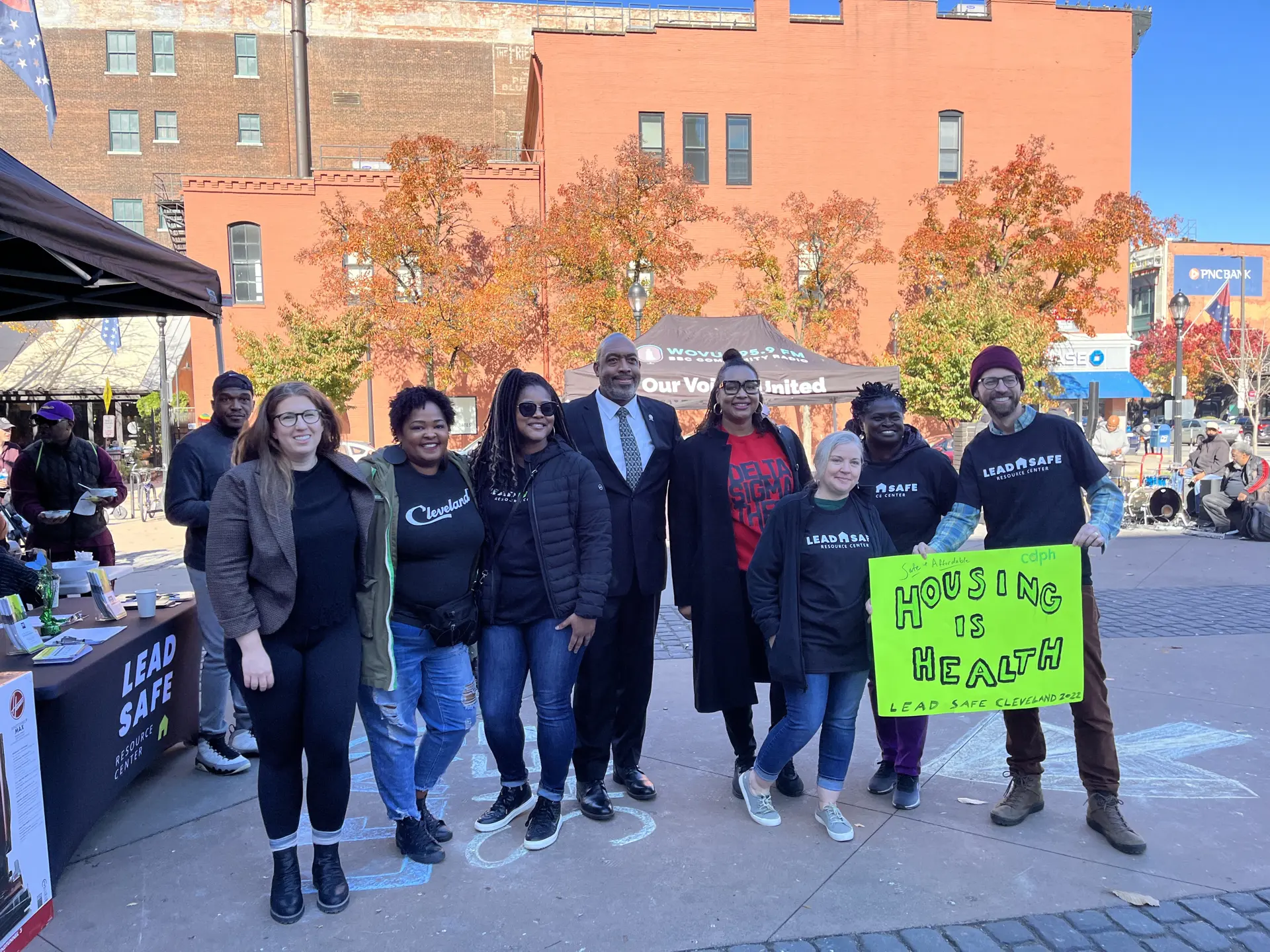
The coalition’s work has produced measurable progress in a relatively short time, particularly in expanding the workforce and increasing testing rates for children.
Cheairs says more than 875 people have been trained to support lead inspections and remediation work, helping address a key bottleneck in the system.
“We’ve also helped increase the number of children who are tested at their well-child visits for lead exposure,” Cheairs says, describing an increase from about 69.3% in June 2025 to 75.7% in February.
Still, the work is complex and often slower than expected. Remediation timelines can vary widely depending on the condition of a home and whether residents are living there during repairs.
Cheairs says the coalition has had to adjust its approach as it better understands the realities of the work.
“We underestimated the complexity of the work remediating homes while people are in them,” Cheairs says, noting that many properties require additional repairs beyond lead removal due to years of deferred maintenance and aging housing stock.
Maurer acknowledges those realities as she shifts from advocacy into administration, a transition that places her inside the very system she once pushed from the outside.
“We need people at every stage of the system — advocates, electeds, and administrators,” she says. “I’m honored to have a chance to have moved between those roles.”
Her background, coalition leaders say, positions her to move quickly and understand the scope of the challenge.
“Former Councilwoman Maurer has always been a champion for preventing childhood poisoning in the city of Cleveland,” Remesch says. “She is probably in a good position to come in and step into the role and hit the ground running.”
The goal is to rebuild trust among residents who have felt let down by the system.
“We have to recognize the history of distrust and frustration on lead poisoning in particular,” Maurer says. “It’s an area where people have felt rightfully betrayed.”
For Cheairs, that distrust reflects the broader and longer-term impact of lead exposure on families and communities.
“This issue impacts us all, and there are generational impacts,” Cheairs says. “Lead exposure has long-term consequences, and there are no symptoms right away.”
That delayed impact makes prevention and early intervention critical, as well as clearer communication about where families can turn for help.
Maurer says success in her role will not come quickly or cleanly. Even meaningful progress may take years to show up in the most important metric: the number of children poisoned.
“Poisoning rates are the best indicator, but those are trailing,” she says. “The payoff on poisoning rates will come years down the line.”
In the meantime, she is focused on more immediate measures, including increasing testing rates, improving how funds are spent and targeting the highest-risk homes.
“I have been a watchdog on slow programmatic spending for years,” Maurer says. “It’s clear to everyone we created too much red tape for our own program.”
She’ll now work to remove those barriers.
“My job moving forward is to make sure that we spend the dollars that are dedicated to improve homes in Cleveland. We need to do that safely, quickly and efficiently.”
Even as she moves inside the system, Maurer says the urgency that defined her work as an advocate remains.
“What I can tell you from the inside is that I’ve never once met a person in the lead-safe system who doesn’t want to do right by this issue,” she says. “Our challenge is building a system to translate that passion into results you can see and feel. That is our responsibility and our promise to Cleveland’s kids.”
For more updates about Cleveland, sign up for our Cleveland Magazine Daily newsletter, delivered to your inbox six times a week.
Cleveland Magazine is also available in print, featuring immersive stories, helpful guides and beautiful photography and design.
Trending
-
1
-
2
-
3
-
4
-
5