
RiverRock Brings Frank Lloyd Wright’s Final Home Design to Life in Willoughby Hills
Last year, daughter-mother duo Sarah and Debbie Dykstra and a team of local architects took on a historic challenge: building the final residential design commission from the famed architect Frank Lloyd Wright. Find out how they stayed true to the blueprint while adapting to modern needs.
by Julia Lombardo | Mar. 2, 2026 | 5:00 AM

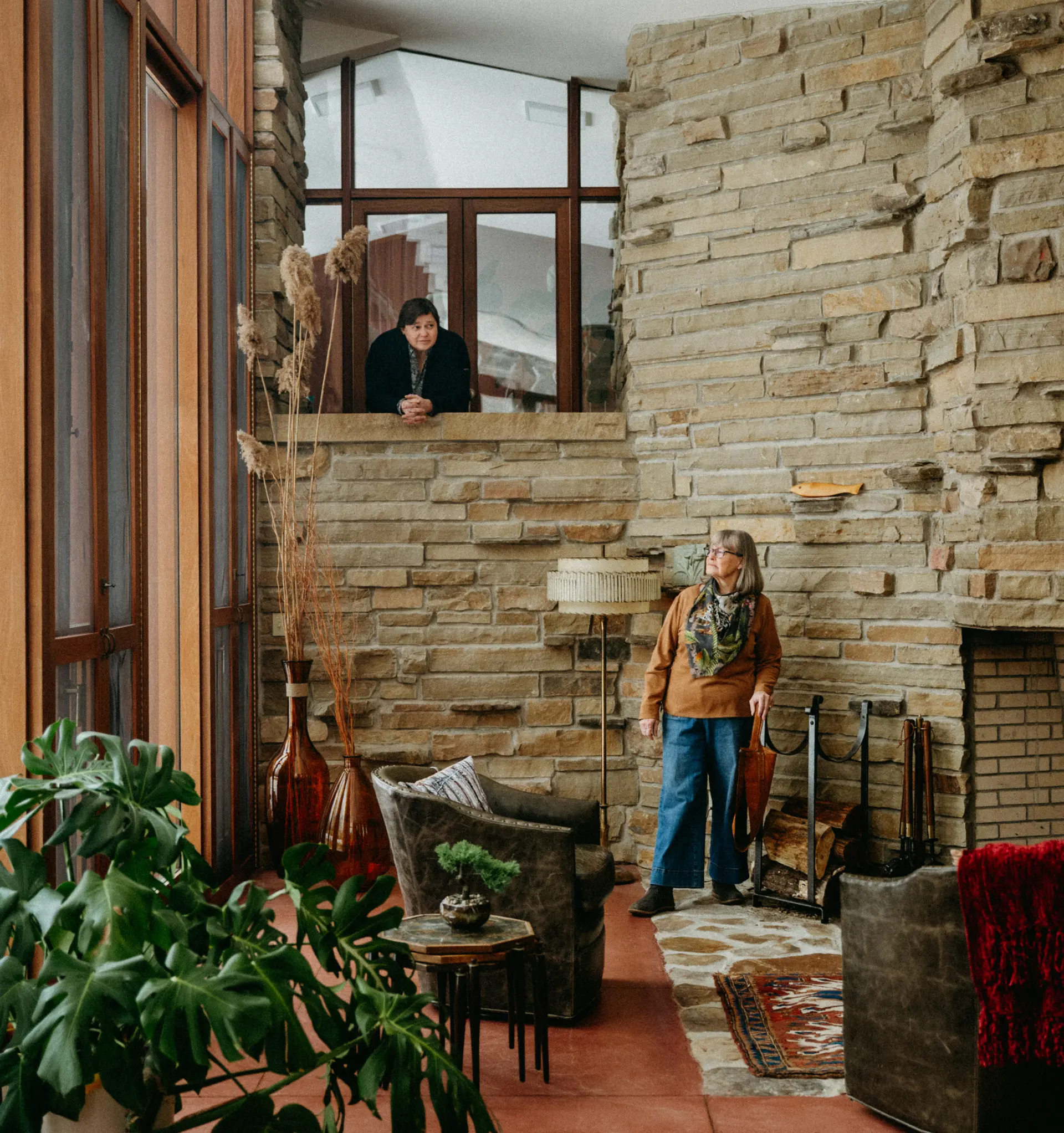
Debbie and Sarah Dykstra. | Photographed by Suzuran Photography
Through a fog of foliage, down a long and winding driveway toward the banks of the Chagrin River in Willoughby Hills, a quaint house called RiverRock lies tucked into the landscape. It appears small, though punctuated by a jutting seafoam blue roof. Rustic stone covers nearly the whole of the exterior; it feels simple. It’s an intriguing, humble outlier to today’s most grandiose houses, but RiverRock is perhaps greater than all of them for its stunning defiance of the century’s architectural style.
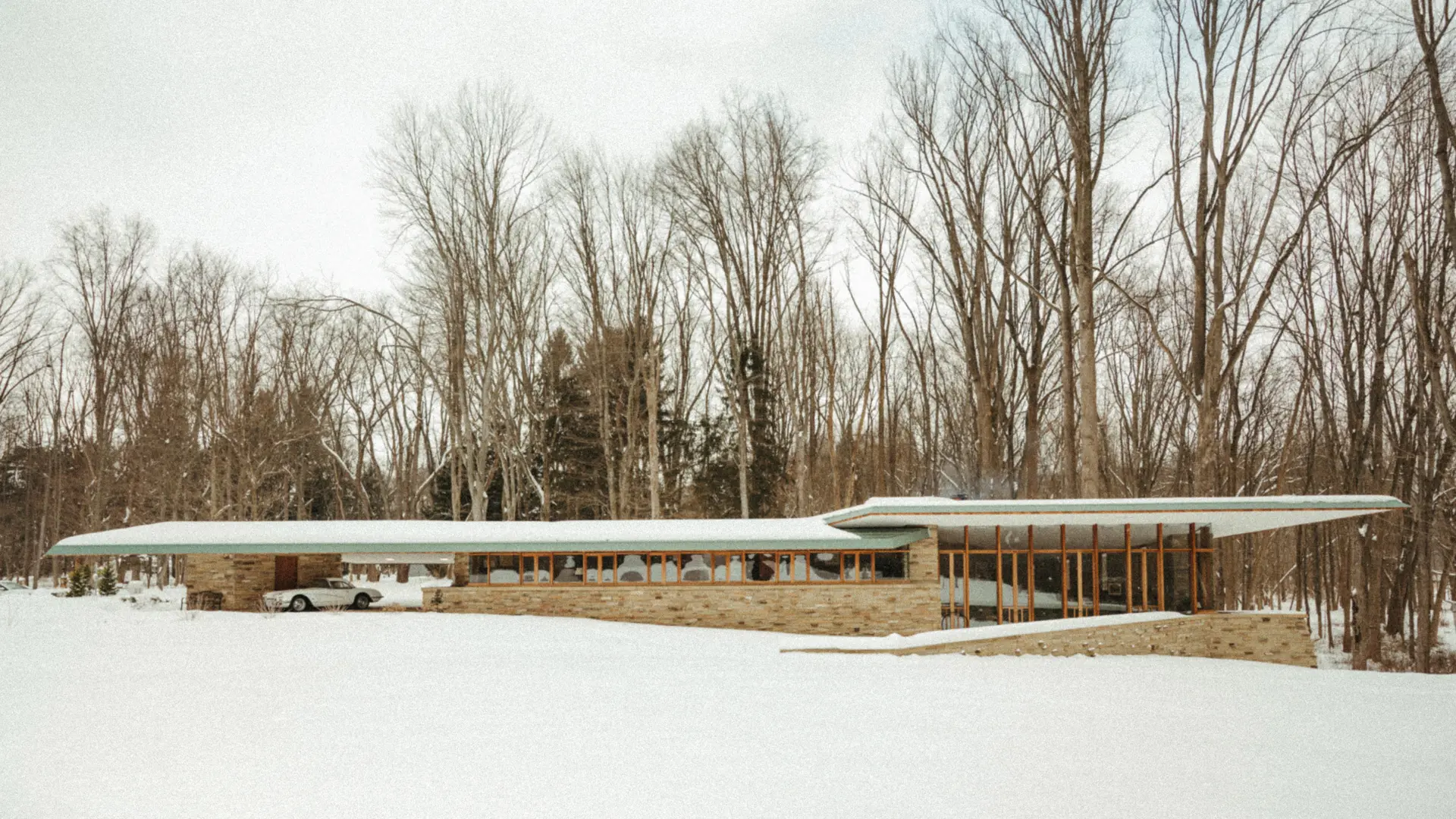
After all, it’s one of the last houses designed by Frank Lloyd Wright, one of America’s greatest architects.
Wright was born in Richland Center, Wisconsin, in 1867, shortly after the Civil War. After a stint in engineering at the University of Wisconsin in Madison, he moved to Chicago, where he started designing in the 1880s. He’s remembered through projects like his Taliesin West studio in Arizona, the Solomon R. Guggenheim Museum in New York, the Imperial Hotel in Tokyo and Fallingwater in Pennsylvania.
Working in the aftermath of three wars, and facing his own spouts of grief and creative blocks, Wright was tested with a constant cycle of folks wanting to start fresh, reconnect with a torn environment and feel at home again.
“He’s thinking of good design as a metaphor for how to lead one’s life well,” says Henry Adams, an art history professor at Case Western Reserve University. “There’s a certain discipline to living, and a Frank Lloyd Wright house encourages you to focus clearly on the things that matter in life.”
RiverRock’s streamlined, single-story layout features quintessential attributes of Wright’s Usonian homes, a group of projects he built primarily in the Midwest, including nine in Ohio. With flat roofs, low ceilings and an L-shaped floor plan, Usonian homes were functional and affordable abodes for the middle class — yet just as grand and cohesive as Wright’s largest projects. He accomplished this through a “compression and release” technique, often with a narrow walkway leading to an open-concept dining and living room.
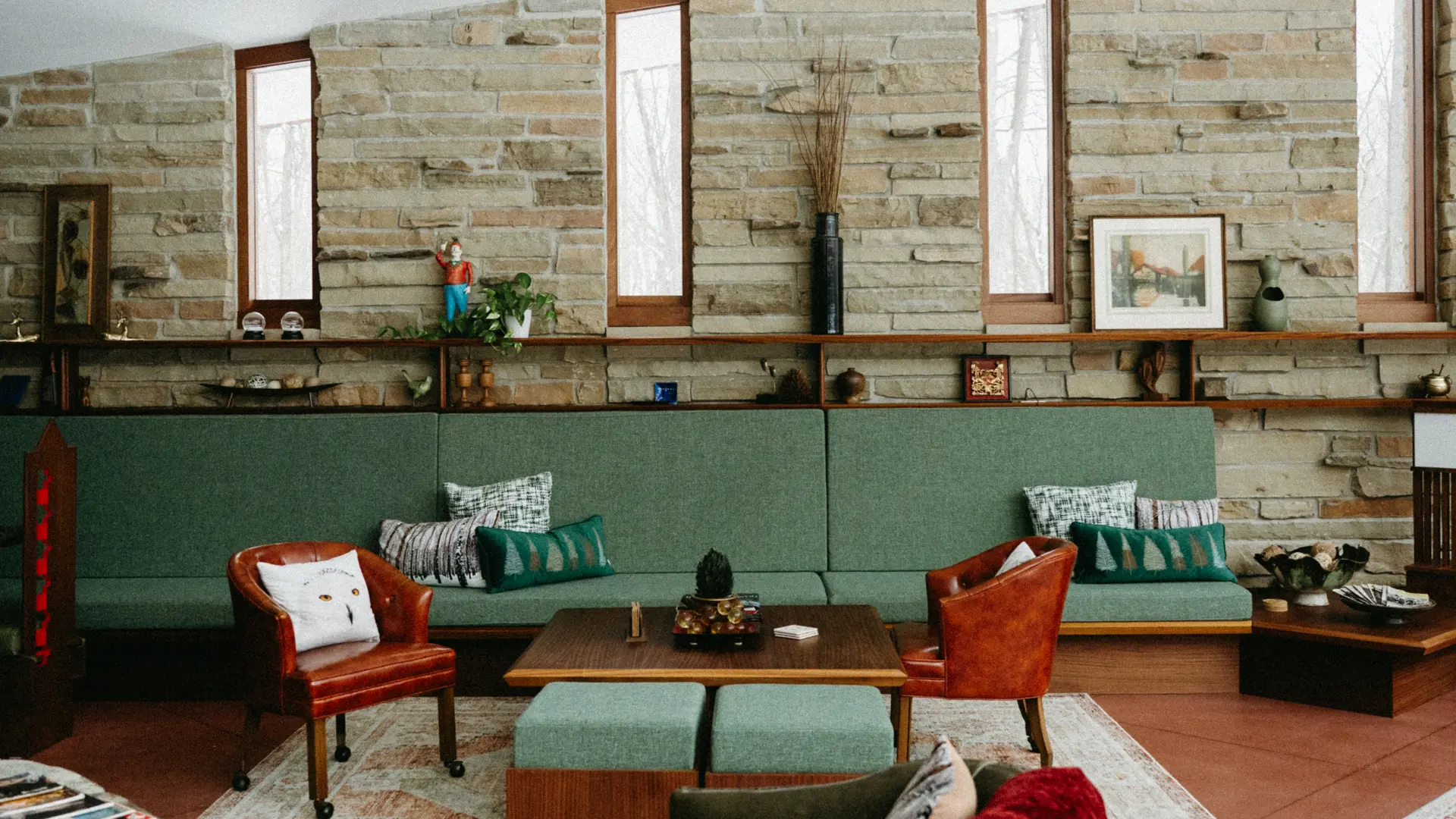
Built-in shelves behind banquette seating help maximize RiverRock’s 2,000 square feet, doubling as a thoughtful display of books, plants, statues and trinkets. When the steps from the foyer break out into an expansive living space, you’re flooded with overwhelming awe.
A motif of stone mirrors itself from the outside, vulnerable to a wall of floor-to-ceiling glass doors shaped by sapele mahogany frames. The room feels transparent, like a bubble in the middle of the woods. One look out into the open field of trees, leaves and endless sky, and the buzz of life melts away. Suddenly, you’re somewhere you have never been before; it’s a new perspective on a familiar landscape.
Despite feeling like a step back in time, RiverRock was built just last year. It sits on the same property as the Louis Penfield House, built by Wright in 1955. Shortly after its completion, the house faced the threat of demolition due to the forthcoming Interstate 90, so Louis Penfield commissioned Wright, nearing the age of 91, to build RiverRock next door, farther from the pending obstruction. But the plans hadn’t progressed by the time Wright died in 1959.
READ MORE: Before RiverRock, Willoughby Hills Had the Louis Penfield House
In picking up pieces after his passing, the blueprint for RiverRock was discovered still on his drawing board as Project #5909 and given to the Penfield family around the time of the architect’s funeral. It is considered Wright’s final residential commission.
“This was the only building that he designed for which there was a full set of drawings and specifications, and the original site was still available,” says Rob Shearer of RWS Architectural Consulting, RiverRock’s on-site architect.
Louis’s son, Paul, kept a grainy copy of the Project #5909 plans in storage. He and his wife, Donna, hoped to save enough money to one day build the house and have them both open to the public.
They never did. In 2018, they sold the Louis Penfield House for a little more than $1 million.
That’s how Sarah Dykstra became the steward of Wright’s local legacy. The Concord Township native was living in Florida at the time with her mother, Debbie, who wanted a house in Ohio for visiting family. Amid a scarce search, Sarah found exactly what she was looking for in two fixer-upper homes off River Road in Willoughby Hills. But a vacant Louis Penfield House sat mere yards away, an enticing offer for a Wright fan like Sarah. It took only one photo of a staircase to pique her interest to buy the entire property with the intention of living in Penfield’s house.
“And then we read the guest book,” Sarah says, “and we decided that we needed to keep it as a guest house. There were so many people who had written stories about coming here, and there’s just a lot of emotions and events that are wrapped up in this house. It didn’t seem quite right to take that away.”
The Louis Penfield House’s listing also included the inheritance of Paul Penfield’s copy of the RiverRock plans — just nine pieces of paper and a lone spec book to some, but to Sarah, it was a polarizing responsibility.
How do you build a Frank Lloyd Wright house without Frank Lloyd Wright?
“We’re very competitive,” Sarah says of her and her mother, “And people kept saying we couldn’t do it. Somebody told me that when we started to build it, we’d hear from all the Frank Lloyd Wright superfans that, ‘You can’t do it,’ ‘He’s not here,’ ‘It’ll never be considered.’ And that had me even more like, ‘Watch me.’”
From day one, the Dykstras had an ultimatum: RiverRock was only going up if it stayed true to Wright’s plans. But whether that was possible still came into question as the house was being staked.
Shearer and lead architect Joseph Myers of Joseph Myers Architects oversaw the project, and Sarah and Debbie stepped in as the general contractors after struggling to find one fit for the job. They had a goal of finishing the house in one year, the same amount of time it took to build Wright’s Fallingwater.
“It was a new topic because I’m not into construction,” Sarah says. “I wasn’t at that point. We weren’t thinking; we were just pressed and pushed. But looking back on it, I don’t see how a contractor could have done it on our timeline and within our certain budget.”
The architects worked with the Penfields’ low-resolution blueprints all the way through the permitting process, needing to go as far as 3D-rendering the design to figure out dimensions.
“There were very few dimensions on the planes,” Myers says. “He set up gridlines through the project, and everything fell on that grid. But he didn’t put dimensions as to where things had to be to fall on the grid.”
“He just kind of made them figure it out,” Shearer adds.
Then, an early breakthrough came when the team was able to acquire a copy of RiverRock’s original files from Columbia University’s Avery Architectural & Fine Arts Library in New York. They received scanned versions of the larger, clearer plans, mending an eyesore that could have clouded the process.
“We just sat there for a day, like, ‘Gosh! That’s what that says!’” Shearer recalls.
“If you look at the plans of Frank Lloyd Wright’s buildings, they’re beautiful in the way that a painting would be a beautiful composition,” Adams says. “There’s a wonderful inventiveness with geometry and shapes. He thinks very creatively about practical issues.”
On the blueprint from 1959, a small tulip tree anchors the entire project. It aligns with the sun’s equinoctial positions in a way that helps it control how light hits the roof’s overhang, which shadows the window line. It cools the space on the hottest days and heats it through the colder months (known as passive solar design). An underfloor heating system adapted from Japanese architectural practices efficiently distributes warmth throughout the house.
That same tulip tree was now sprawling and butting up concerningly close to the home. Before breaking ground, Sarah was advised to reorient the building for the sake of breathing room, but she knew the tree was a pillar in the project’s purpose. She couldn’t reconcile with changing that.
“I always liked the art of his buildings,” Sarah says. “I think that’s why we were so adamant about it looking the same outside on the skin, and how we weren’t going to rotate the house.”
Other modifications came easier. When the concrete color and wood shade that Wright included in his spec book were deemed no longer available, the team workshopped a slew of swatches to find the closest alternative.
It’s impossible to know how Wright would have adapted to the overflux of man-made materials by the time construction began on RiverRock in the fall of 2023. Even as industrialization and factory-produced materials like steel, concrete and fiberglass ramped up in the 1940s, architects of the postwar era were tasked with creating living spaces that didn’t feel like cogs in a machine. Wright stayed grounded through a continuous prioritization of natural resources, in tandem with manufactured counterparts.
“I think a key word for Frank Lloyd Wright is ‘organic,’” Adams says. “He likes to use materials in a way that reveals what they are, rather than covering them up with historical decoration. He does sometimes use materials that are not organic in the usual sense, but every part is integrated with the whole.”
Wright’s plans also required a “regional or local stone,” which the team gathered from cuts called Indian Creek and Meadow Ridge at Van Ness Stone Inc. in Newbury, and they even incorporated stones from the Penfields’ backyard, which Louis pulled out of the Chagrin River with the intention of using them to build RiverRock. No detail was left behind.
The house was only going up if it stayed true to Wright’s plans.
But it was only staying up if it could support itself. When it came to making changes for the sake of sustainability, the Dykstras, Myers and Shearer were challenged by the reality that they couldn’t ask Wright for input.
“We were given a pretty clear direction to not change the aesthetic,” Shearer says.
He notes that the most major structural changes weren’t that major at all, such as selecting a more durable and weatherproof metal for the 164-foot roof, widening the mullions at the front of the house for stability, and opting for double-pane windows. The latter, Shearer recounts, posed larger questions about changing the windows’ stops, a tweak that could have simplified installation, but ultimately would interrupt Wright’s gridlines and overall design.
“Those kinds of things were the challenge of bringing it up to modern technology, but keeping that 1959 look and feel to it,” Shearer says.
“It’s not like anything that we’re doing now, in terms of the layout,” Myers says of the house.
Throughout the process, they were consoled by blessings from visitors like Ashley Mendelsohn, a former assistant curator at the Guggenheim Museum, and Bing Hu, a former apprentice at Wright’s Taliesin studio who helped restore one of the architect’s projects in Arizona. For Sarah, this was as close as she could get to Wright’s approval.
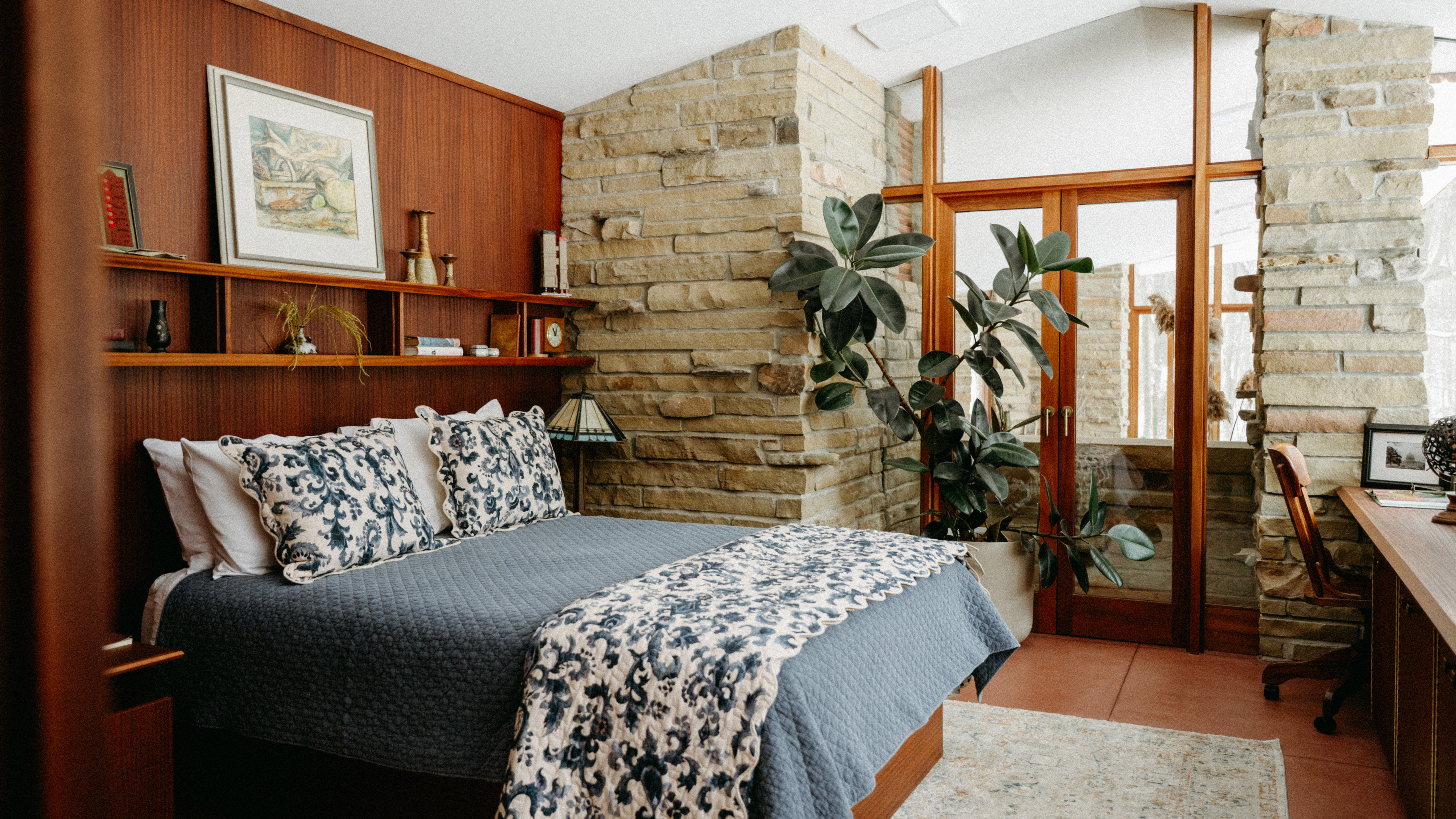
RiverRock's first bedroom features an indoor Juliet balcony. | Photographed by Suzuran Photography
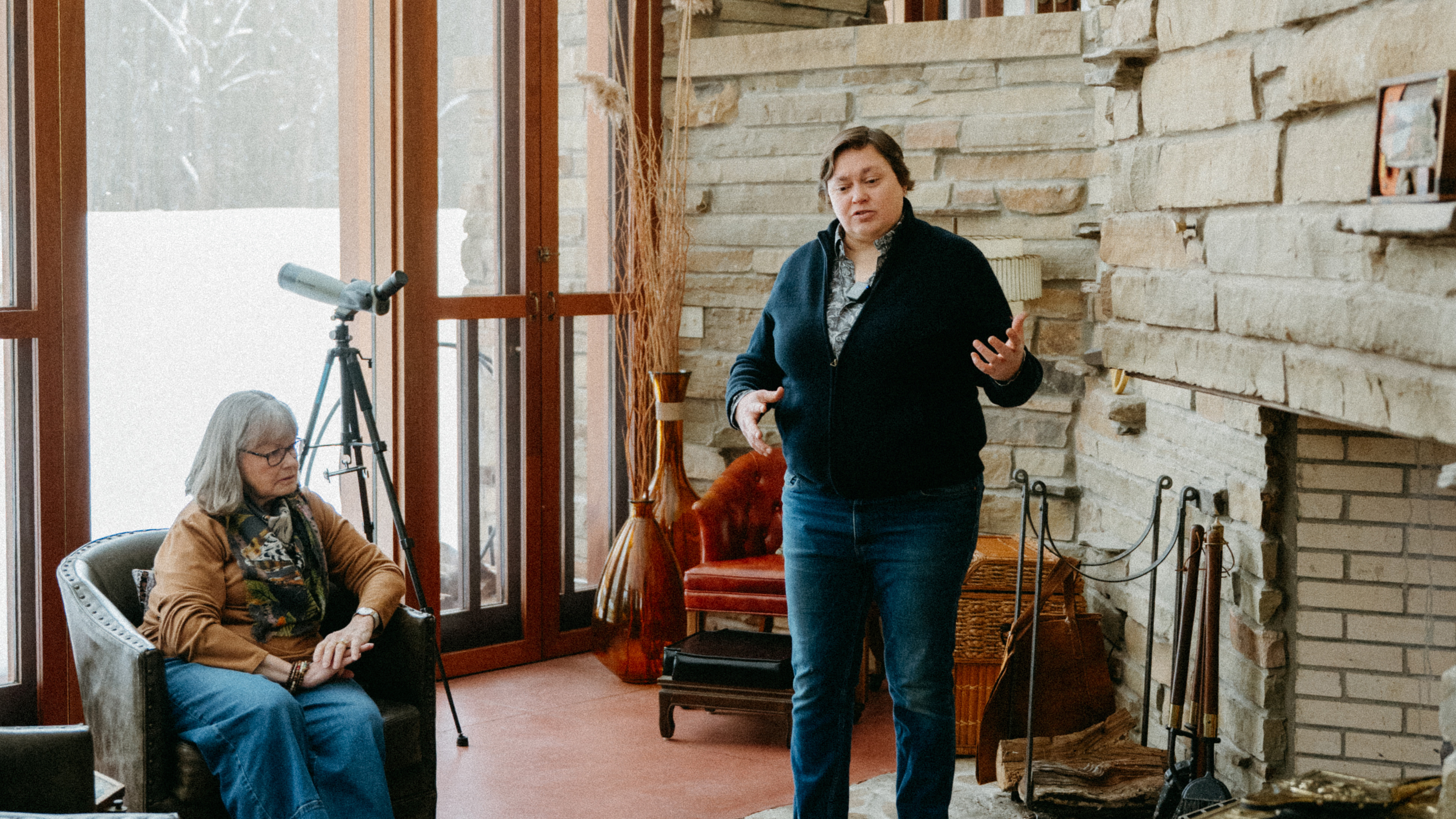
The living room is centered around a fireplace. | Photographed by Suzuran Photography
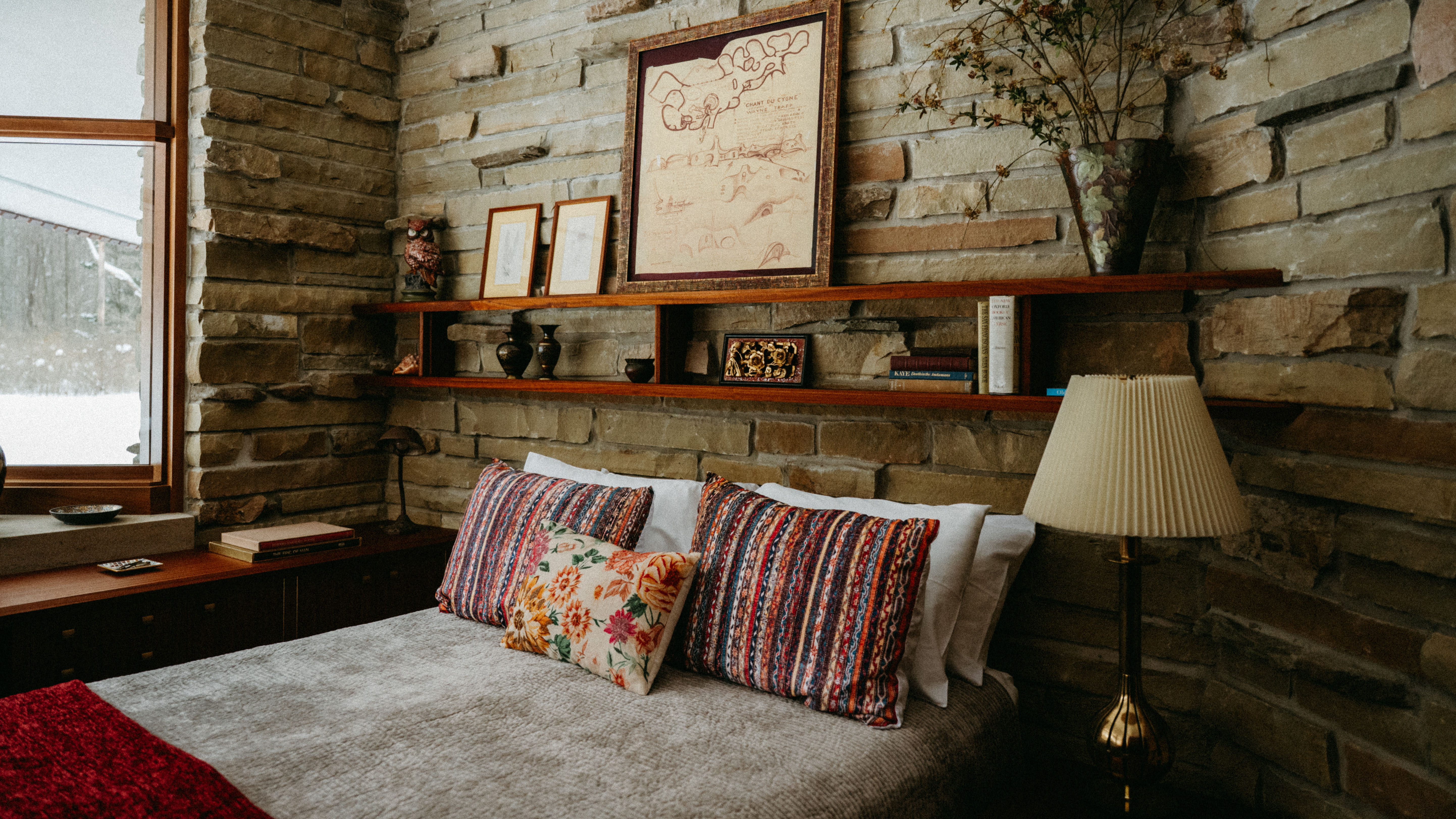
The third bedroom is situated at a corner of the house. | Photographed by Suzuran Photography
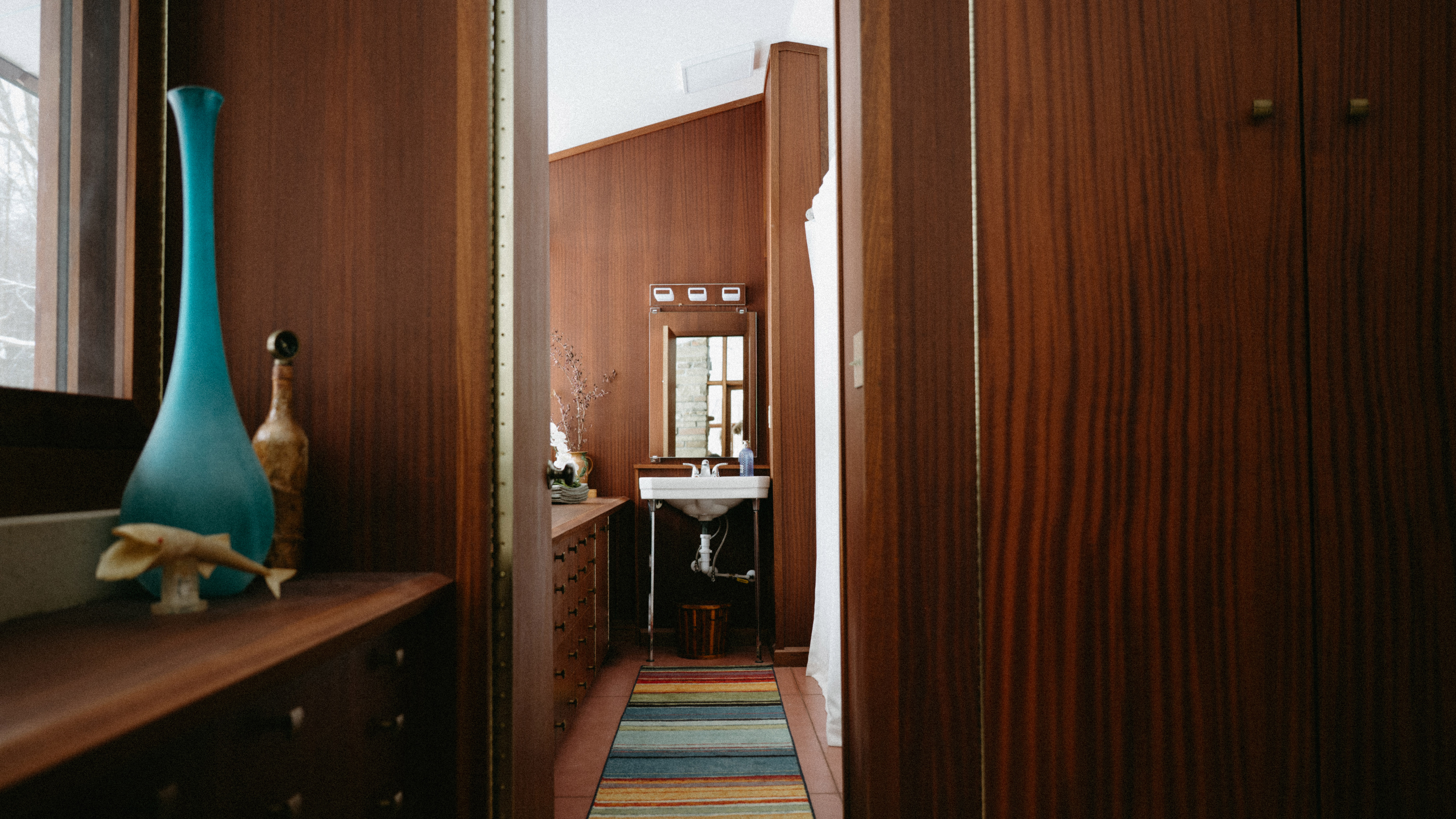
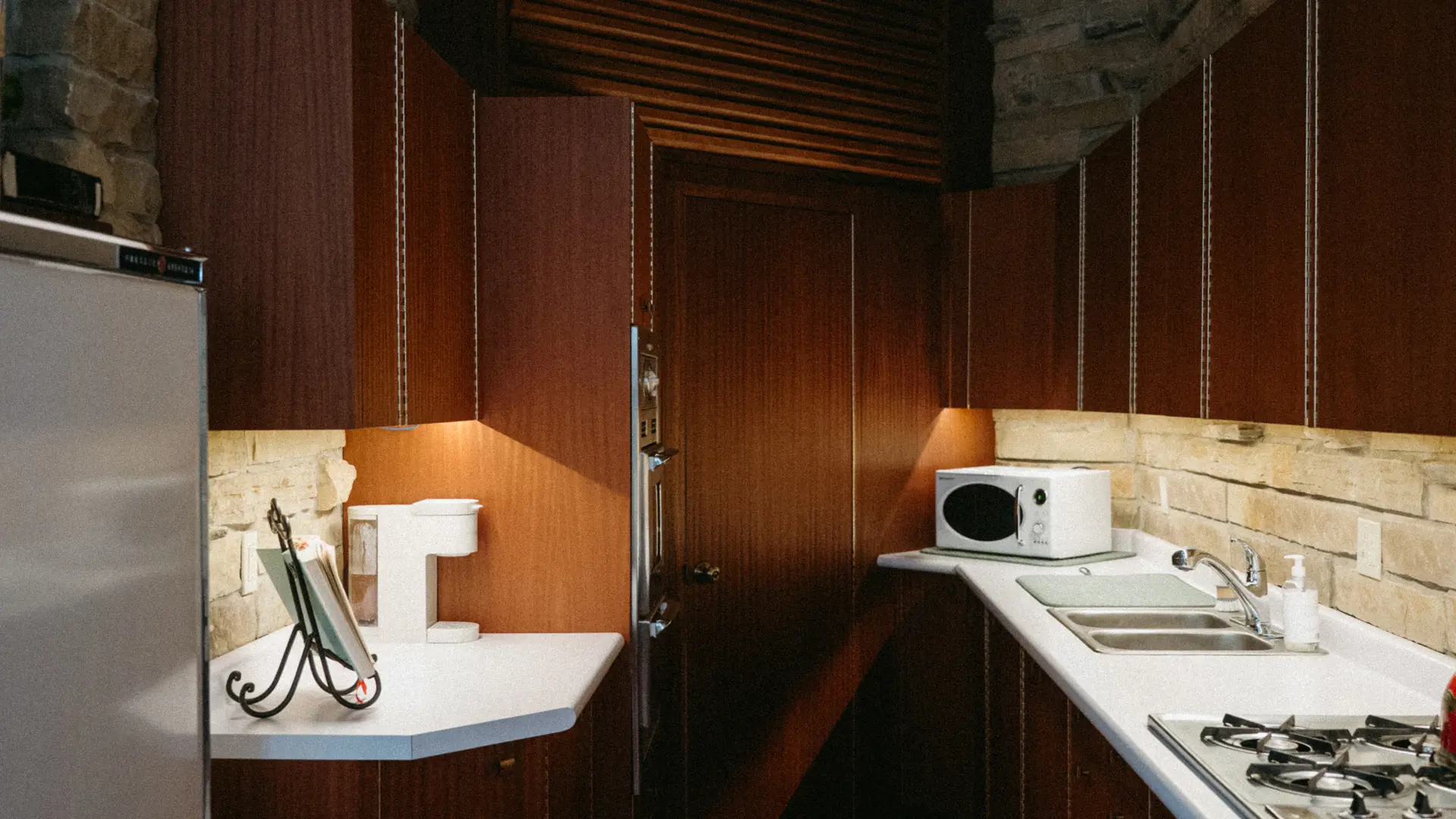
Each bathroom is small and narrow. | Photographed by Suzuran Photography
Other touches remained very “Frank,” such as the underfloor heating system and his “one-to-five” rule, which required that stones were never square and were cut five inches wider than every inch in height. An indoor Juliet balcony sits off the first of three bedrooms, which Sarah quips has doubled as a theater stage for children visiting the house. The unique feature overlooks the living room, where two leather chairs are positioned in front of a hearth. While today’s homes center around a television, Wright created gathering places around a fire to bring focus to nature’s grounding ambiance.
The third bedroom, which meets the end of the roof, comes together into an intriguing, asymmetrical shape. Shearer calls it his favorite room for the way it “resolves all the different angles of the house.”
“Every single piece of the plans had a purpose,” Sarah says, “That was mesmerizing to me.”
The spec book even included plans for building wooden furniture, instructions on where to place it in the house, and guidance on specific models for certain fixtures. But with no exact direction for the interior design, the Dykstras got to make their own personal touches.
“There were three ways we could go,” Debbie says. “The Jetsons look, midcentury modern, strictly, or as if a real family was living there. And I felt that it should be a real family, because with people coming to stay, things are going to remind them of growing up. And that’s what we found out right away. They go into the kids’ room, and they see all this stuff that they had when they were kids. With all the rock in there, it’s warm already, so you just need to make it feel like it belonged to somebody, not just a museum.”
From a combination of Facebook Marketplace and vintage stores, the Dykstras used their eye for design and keen intuition to collect almost everything secondhand: furniture, decor and appliances. Sarah and Debbie recall driving all the way to Kansas just to pick up the exact bathroom sink from Wright’s specs, then stopping at antique and thrift stores all along the route to shop for more decor.
The mother and daughter continue down memory lane, recounting a flood just a few days after the home’s concrete floor was laid, staining its Roycroft copper red hue and forcing them to scrub the surface with baking soda and a toothbrush.
While the two despised the cleanup, the moment proved pivotal for Sarah.
“I felt pressure both from Wright as well as Louis,” she admits. “Probably somewhere around when the floor was poured, it started to change to ours, where I didn’t feel like it was Louis’s house anymore. Because at first, I really did. I mean, he commissioned it, and Paul sold the house to me with the hope that we would (build) it, and the promise that we would try to get it done the best we could.”
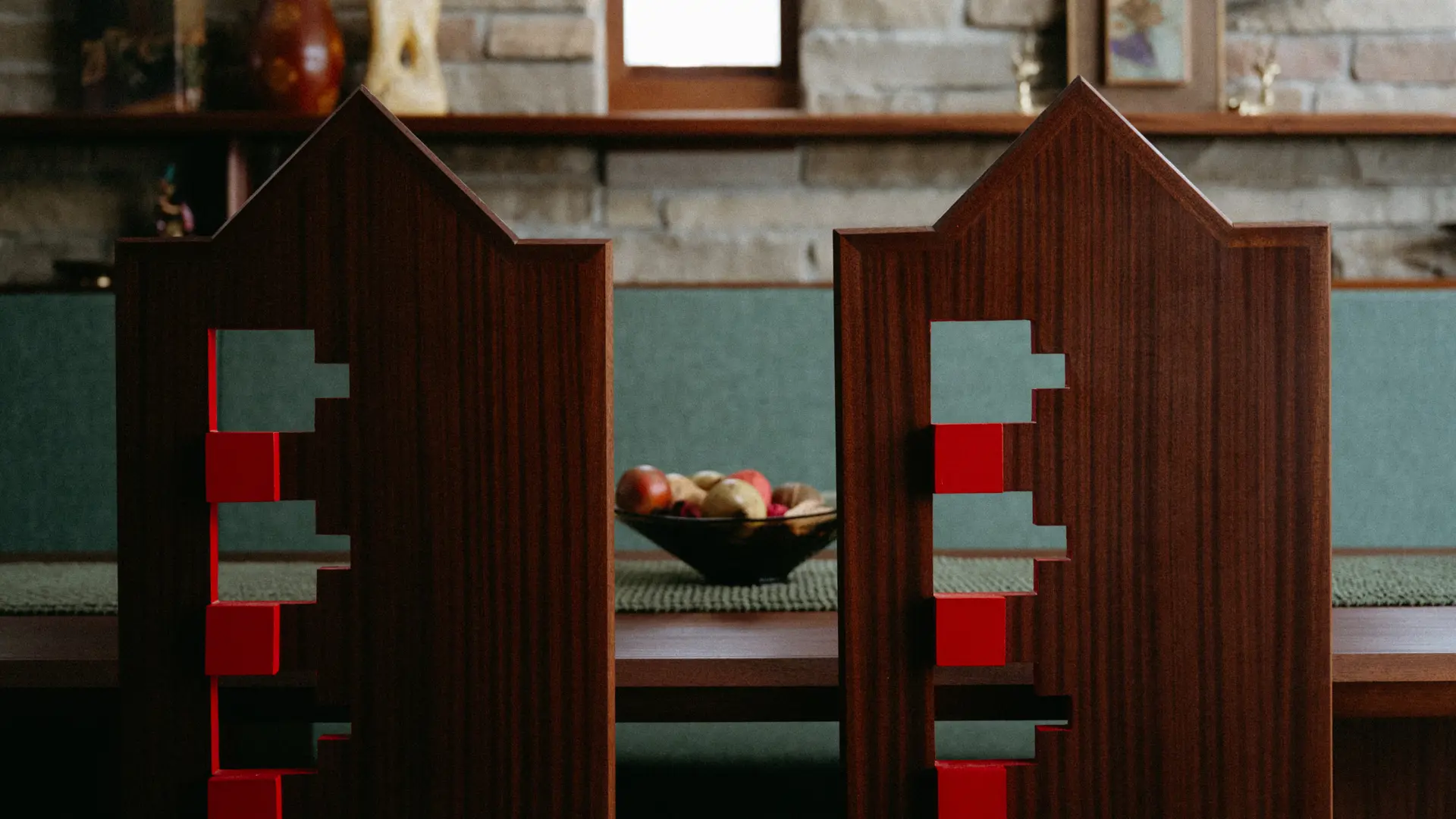
Contrary to Wright’s philosophy of livable and functional homes, today the architect’s spaces can feel like museums that you’re almost scared to touch.
Sarah sees beyond that sanctity. As RiverRock’s owner, she’s constantly upkeeping each room and tidying for the overnight guests that she coordinates year-round. She’s comfortable moving through this space, mindlessly picking up stray blankets or grazing a straight of cabinet doors with her fingertips.
In the dining area, she pushes out one of four custom-made wood chairs and traces a row of red, square cutouts on its rectangular back. Sarah hand-painted each cutout alongside her mother, who scoffs at the memory of taking off all the strips of painter’s tape. Debbie then stops to rearrange some decorations near the kitchen, noticing one cluster of four items.
“It’s easier on the eyes to accept an odd number,” she asserts as RiverRock’s decor expert.
Sarah simultaneously opens up a row of magazines in the living room as she continues to find bookmarks she didn’t place there. Each displays some Mandarin text over different images. She concedes it’s just another Easter egg left by a guest. Those visitors range from architects to casual enthusiasts, folks that have never lost touch with the gravity of Wright’s work.
RiverRock opened to the public with a ribbon cutting on Feb. 28, 2025. The massive scissors are still perched on an exposed stone shelf in the living room. It was 18 months of labor and love done seemingly under the radar, until The Last Wright debuted on HBO Max in September, which brought a professional production crew to a small slice of Northeast Ohio and detailed nearly the entire experience in four 40-minute episodes.
Though the Dykstras had always planned on documenting RiverRock’s construction process in a series of photos and videos, they never intended to play the starring role.
“We wanted Brad Pitt to host,” Debbie exclaims.
“We thought that he should either be the narrator of a documentary or be a host,” Sarah continues. “He’s very much into Frank Lloyd Wright and architecture. But then our second executive producer said, ‘That’s not how they do it these days. You guys are in it.’ I thought, They’ll fire us after one episode.”
But they made it through, and did it with grace and poise. The cozy family feel that brings RiverRock to life shines through every candid moment that the mother and daughter show on camera.
“We created memories we’ll never forget, that we would have never had the opportunity to,” Debbie says, conceding that above all, she loved the experience simply because she got to do it with Sarah.
RiverRock is already cherished like other Frank Lloyd Wright projects, receiving lots of love from his online fan clubs and Facebook groups, and guests have flocked from France, England, Seattle, Philadelphia and beyond for an overnight stay. But it falls short on formal recognition due to its posthumous nature.
The Frank Lloyd Wright Foundation famously supports Wright-built projects through events, donations and volunteer opportunities. While RiverRock’s plans are mentioned in conjunction with the Louis Penfield House on the Foundation’s site, the completed home is compromised due to the Unbuilt Projects Policy.
“While contemporary architectural designs by others inspired by the work Wright created during his lifetime continue to broaden his legacy, newly constructed or reconstructed projects that are based on designs, sketches, working drawings, and/or photographs of Wright’s work cannot faithfully represent the intentions of Wright himself,” the Foundation’s policy says. “Historically, the process of construction of his many built works was typically facilitated by his own on-site representatives so as to ensure conformity to working drawings and their intentions. This is, of course, not possible today.”
Missing this one gold ribbon doesn’t make the achievement any less sweet for RiverRock’s build team. It was never the motive; it was always for the love of the craft.
“It’s fun being a living part of your hero’s dream,” says Myers, who’s been an architect for almost 40 years.
“Martial arts people say, ‘You don’t know somebody until you fight them,’ right?” Shearer says. “For an architect, to build something from somebody else’s plans, that’s getting to know them in a very intimate way.”
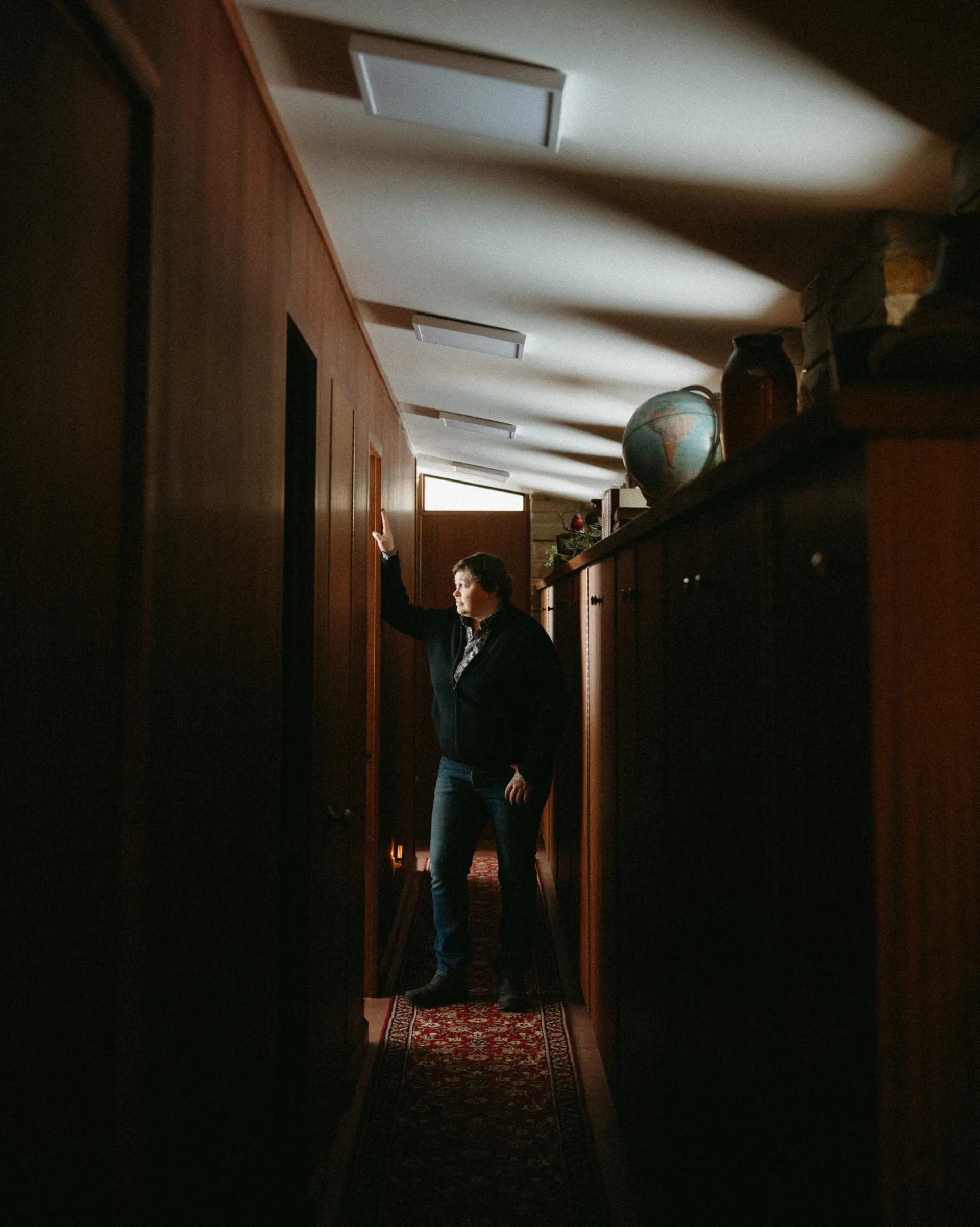
Sarah has made this adage part of her own life as the caretaker of both RiverRock and the Louis Penfield House, on call for cracks, scratches, crannies to clean and other mishaps. In fact, maintaining both a 1955 and 2025 home leaves her with fewer regrets about her team’s design modifications on the latter project.
“(Wright) would not like the fact that people have pinned him with leaky roofs and saggy cantilevers,” Sarah asserts. “If he could improve upon his designs with better technology and products, he would have done that. There’s no doubt in my mind.”
The preservation of Wright’s remaining projects is proof of why design movements like midcentury modern and modernism remain relevant today, even decades after his death. Their timeless style ironically honors the same organic, fluid and minimalist principles that Wright prioritized, but in a more commercialized way.
READ MORE: Local Designers and Educators Define Midcentury Modern
When he created houses to break the mold of each one looking the same, he dreamt big — perhaps too ahead of his time — as contemporary architecture returned to monotony and left expression to the interior.
“He was thinking of technical possibilities with new materials that hadn’t been explored before,” Adams says. “He was creating houses that encourage you to turn your life into a work of art.”
Most days, Sarah finds herself still caught up in the busyness of the past two years. RiverRock is an ongoing project, she says. She doesn’t think about her favorites in rooms, but rather, moments when the ever-changing landscape slows and the muse starts to make sense.
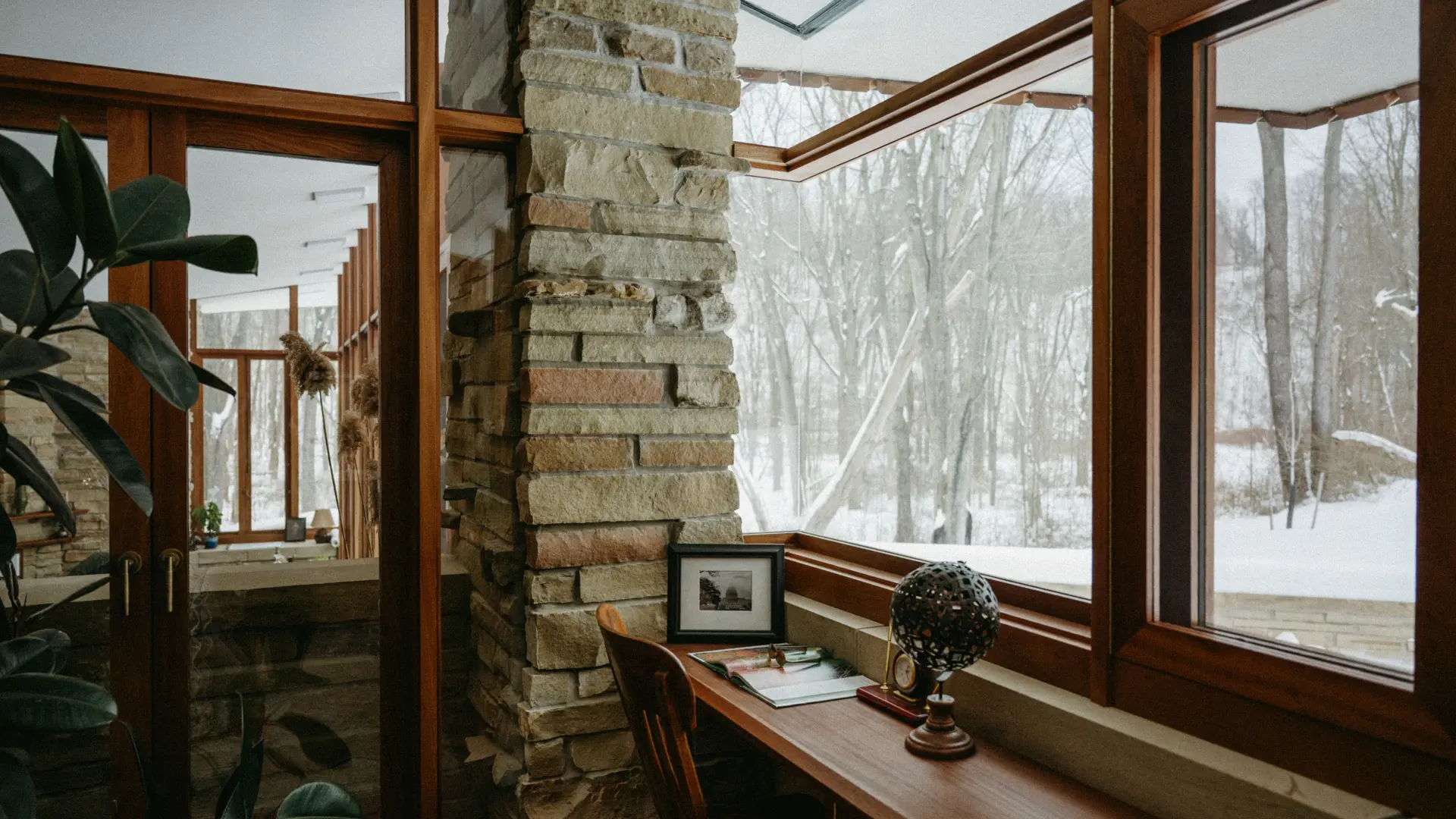
“Winter,” she says simply. “It’s really quiet. The snow absorbs the sound, you can see out to the river, and you can see more of the animals in the woods. I love it.”
RiverRock is the last of Wright’s residential works, as we know it, but it isn’t as final as it seems. It’s a stop in a cycle of the architect’s infinite influence on the world of design, both in ways we see — and things we might miss if we don’t stop to pay attention.
For more updates about Cleveland, sign up for our Cleveland Magazine Daily newsletter, delivered to your inbox six times a week.
Cleveland Magazine is also available in print, featuring immersive stories, helpful guides and beautiful photography and design.

Julia Lombardo
Julia Lombardo is the editor of Cleveland Magazine’s home and style section and contributes to coverage of arts, culture and dining. She graduated from The Ohio State University in 2023 with an English degree. As both a journalist and poet, she is inspired by stories with creative flair. When she puts down the pen, she enjoys going to concerts, ranking coffee shops and walking aimlessly through wooded trails.